| | |
| | |
\documentclass{standalone}
\usepackage{tikz}
\usepackage{tikz-qtree}
\begin{document}

\tikzset{font=\small}

\begin{tikzpicture}
    \Tree [.A
             [.\node(B){B}; ]
             [.\node(C){C}; ]
          ]
\begin{scope}[xshift=0in,yshift=-2cm]
    \Tree [.\node(Dx){D};
             [.E ]
             [.F ]
          ]
\end{scope}

\draw[-] (B) -- (Dx);
\draw[-] (C) -- (Dx);
\end{tikzpicture}
\end{document}
|
PDF |
 |
| | |
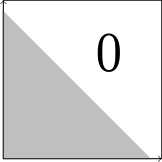
\documentclass{standalone}
\usepackage{tikz}
\begin{document}
\begin{tikzpicture}

\draw [<->] (3,0) -- (0,0) -- (0,3);
\draw (0,0) rectangle (3,3);
\draw [fill=lightgray] (0,2.8)--(0,0)--(2.8,0);
\node [font=\Huge] at (2,2) {$0$};


\end{tikzpicture}
\end{document}
|
|
 |
| | |
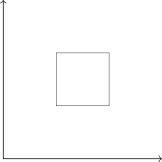
\documentclass{standalone}
\usepackage{tikz}
\begin{document}
\begin{tikzpicture}

\draw [very thin] (1,1) rectangle (2,2);
\draw [<->] (3,0) -- (0,0) -- (0,3);


\end{tikzpicture}
\end{document}
|
|
 |
| | |
| | |
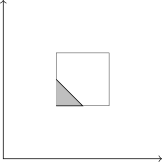
\documentclass{standalone}
\usepackage{tikz}
\begin{document}
\begin{tikzpicture}

 \draw [<->] (3,0) -- (0,0) -- (0,3);
 \draw [very thin] (1,1) rectangle (2,2);
 \draw [fill=lightgray] (1,1)--(1.5,1)--(1,1.5);


\end{tikzpicture}
\end{document}
|
|
 |
| | |
| | |
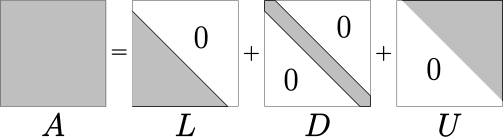
\documentclass{standalone}
\usepackage{tikz}
\begin{document}
\begin{tikzpicture}

 \def\x{0}%
  \def\y{0}%
   \draw [very thin] (\x,\y) rectangle (\x+2,\x+2);
   \draw [fill=lightgray] (\x,\y)--(\x+1.75,\y+0)--(\x+0,\y+1.75);
   \node[font=\Huge] at (\x+1.25,\y+1.25) {$0$};
   \node at (\x+2.25,\y+1) {$+$};

\end{tikzpicture}
\end{document}
|
|
 |
| | |
| | |
\documentclass{standalone}
\usepackage{tikz}
\begin{document}
\begin{tikzpicture}
  \path[draw] (0,0) rectangle (2,1);
\end{tikzpicture}
\end{document}
|
PDF |
|
| | |
\documentclass{standalone}
\usepackage{tikz}
\begin{document}
\begin{tikzpicture}
  \path[fill,draw] (0,0) rectangle (2,1);
\end{tikzpicture}
\end{document}
|
PDF |
|
| | |
\documentclass{standalone}
\usepackage{tikz}
\begin{document}
\begin{tikzpicture}
  \path[shade,draw] (0,0) rectangle (2,1);
\end{tikzpicture}
\end{document}
|
PDF |
|
| | |
\documentclass{standalone}
\usepackage{tikz}
\begin{document}
\begin{tikzpicture}
  \path[shade,top color=yellow!80!black,
        bottom color=white,draw] (0,0) rectangle (2,1);
\end{tikzpicture}
\end{document}
|
PDF |
|
| | |
\documentclass{standalone}
\usepackage{tikz}
\usetikzlibrary{trees}
\begin{document}
\begin{tikzpicture}
  \node {A}
      [edge from parent fork down]
      child {node {B}}
      child {node {C}}
   ;
\end{tikzpicture}
\end{document}
|
PDF |
|
| | |
\documentclass{standalone}
\usepackage{tikz}
\usetikzlibrary{trees}
\begin{document}
\tikzset{every node/.style={draw,
                            rectangle,
                            rounded corners
                           }
        }

\begin{tikzpicture}
  \node {A}
      [edge from parent fork down]
      child {node {B}}
      child {node {C}}
   ;
\end{tikzpicture}
\end{document}
|
PDF |
|
| | |
\documentclass{standalone}
\usepackage{tikz}
\usetikzlibrary{trees}
\begin{document}

\tikzset{level 1/.style={sibling distance=2cm},
         level 2/.style={sibling distance=1cm}}

\begin{tikzpicture}
  \node {A}
      [edge from parent fork down]
      child {node {B}
         child {node {B1}}
      }
      child {node {C}
         child {node {C1}}
         child {node {C2}}
         child {node {C3}}
      }
   ;
\end{tikzpicture}
\end{document}
|
PDF |
|
| | |
see http://tex.stackexchange.com/questions/124862/how-to-draw-a-d
iagram-that-forks-out-then-joins-in-the-middle-then-forks-out-ag
%written by Qrrbrbirlbel at Tex stackexchange
\documentclass[tikz]{standalone}
\usetikzlibrary{positioning-plus,paths.ortho}
\tikzset{
  parents/.style 2 args={
     @parents/.style={insert path={edge[edge from children path] (#1-##1)}},
     @parents/.list={#2}},
  edge from parent path={
    (\tikzparentnode\tikzparentanchor) |-| (\tikzchildnode\tikzchildanchor)},
  edge from children path/.style={
    to path={
      (\tikztostart\tikzchildanchor) |-| (\tikztotarget\tikzparentanchor) \tikztonodes}}
}
\begin{document}
\begin{tikzpicture}[
  node distance=\tikzleveldistance and \tikzsiblingdistance,
  on grid,
  text depth=+0pt,
  hvvh=from center
  ]

\node (A) {A}
  child {node {B}}
  child {node {C}};
\node[below=2:of A] (E) {E} [parents={A}{1,2}]
  [sibling distance/.expanded=2*\the\tikzsiblingdistance]
  child {node {F}
    child {coordinate
      [anchor=center,sibling distance/.expanded=.5*\the\tikzsiblingdistance]
      child {node {N}}
      child {node {Q}}
    }
    child {node {R}}
  }
  child {node {G}}
  child {node {H}};

\node[below=of (E-2)(E-3)] (L) {L} [parents={E}{2,3}]
  child {node {M}}
  child {node {N}}
  child {node {K}}
;
\end{tikzpicture}
\end{document}
|
PDF |
|
| | |