6.2 Lab 2, Simulate moving mass on spring inside slot on a moving table
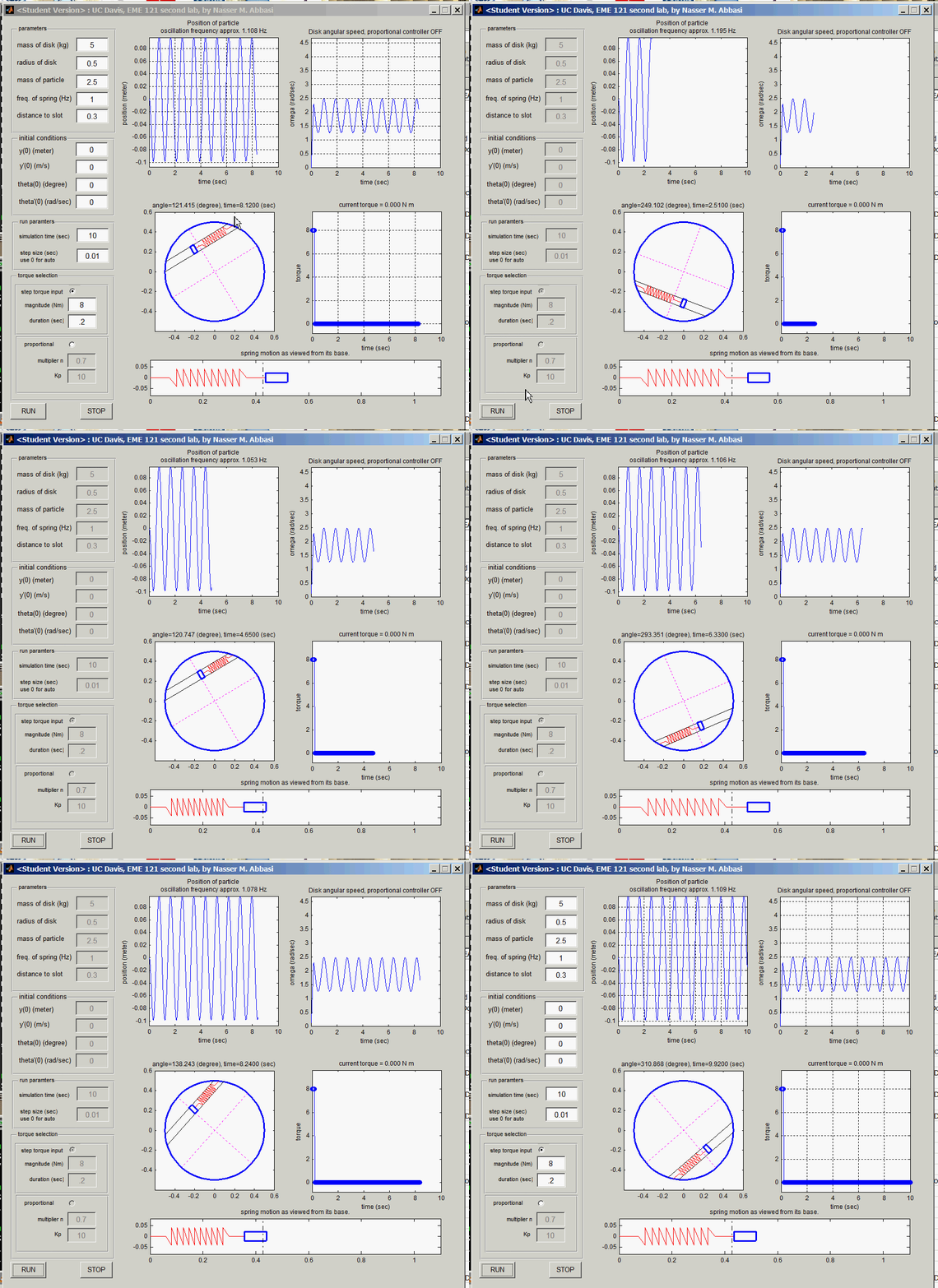
This Lab assignment is to study motion of circular disk with mass on spring moving in a slot on the table.
6.2.1 Problem description
The simulation assignment is to reproduce Example 3.2 in your book for the pinned disk with a slot and mass particle. Turn in your computer file with the equations you simulated and plots that show that your simulation worked.
An addendum to the problem is in this
6.2.2 Physical model
The following diagram shows the physical model of the system. It is a horizontal table, with a slot in it, where a mass \(m\) attached to spring that moves with no friction inside this slot.
In the above, the frame of reference for the moving mass \(m\) has its origin coincide with the origin of the inertial frame. The vector \(a\) is always perpendicular to the slot, and it is assumed the mass \(m\) when the spring is relaxed will be located at the end of the vector \(a\) and hence \(y\) is measured related to that location.
6.2.3 Mathematical model
The system has 2 degrees of freedom \(\theta \) and \(y\). The 2 equations of motion will be derived using both the \(F=ma\) and using Lagrangian method.
Deriving equations of motion using \(F=ma\)
The following is the velocity, acceleration and force diagrams
Now that we have the acceleration and the force diagrams, we can write the equations of motion using \(F=ma.\)
There are 3 unknowns in the problem \(\theta ^{\prime \prime },y^{\prime \prime }\) and \(N\), the reaction force on the side of the slot wall. Hence we need to generate 3 equations.
Apply \(F=ma\) in the direction parallel to the \(a\) vector we obtain
Applying \(F=ma\) in the direction parallel to the \(y\) vector gives
Applying moment equation for the disk results in
Therefore, the final EQM are
Decoupling the EQM and the state space formulation
Substituting Eq. (5) into Eq. (4) gives
Simulation results and discussion
First, the 4 figures shown in the textbook at page 100 and 101 are reproduced below using the simulation program written for this assignment.
Figure 3.7 and 3.8 reproduced
When the spring is made very stiff (\(f_{n}=200\) Hz) then the mass attached to the spring had almost no moment. Therefore, the system behaved as if the mass was just placed on the table, and no reactive force was generated on the side of the table due to spring extension. The generated solution agrees with this result as shown below.
All other simulation parameters used are as shown in table 3.2, page 99 in the textbook.
Figure 3.9 and 3.10 reproduced
Now the simulation parameters were all set to the same values in table 3.2, and the following is the result:
We can see that now, since the spring is extended and contracting, then there will be reactive force on the table at the point where the spring is attached to it. This force will change in value as the mass move up and down the slot. Therefore this resulted in the disk angular speed changing as shown above. We notice now that the mass position produces oscillatory motion around the point of static equilibrium of the spring.
Results when proportional controller added
The input torque applied to the disk is now given by
| \(n\) | \(\omega _{des}\left ( rad/\sec \right ) \) | mass oscillation (Hz) |
| \(0.5\) | \(3.142\) | \(0.92\) |
| \(0.6\) | \(3.77\) | \(0.81\) |
| \(0.7\) | \(4.398\) | \(0.708\) |
| \(0.8\) | \(5.027\) | \(0.609\) |
| \(0.9\) | \(5.655\) | \(0.41\) |
| \(0.95\) | \(5.969\) | \(0.306\) |
| \(0.99\) | \(6.22\) | mass fell off the edge |
We notice that as the \(\omega _{des}\) approached or exceeded the natural frequency of the spring, then the mass will oscillate such that the amplitude became larger than the distance it has available to it on the top of the disk, and the mass fell over, and the simulation was stopped then. The simulation program detects when the mass position is outside the disk and will terminate the simulation. This can be attributed to resonance, since at resonance the amplitude becomes very large. The following plot shows the above result to confirm the inverse relation between mass oscillation and the disk angular speed
The mass position amplitude damped out during oscillation in all the above runs was, but the oscillation was clear and was measured in the program by counting how many times the mass crosses its position of static equilibrium. The following plot shows the output from one typical run showing the damped motion of the mass.