4.1.1
4.1.1.1 problem number 280
Added Nov 20, 2019
Solve Laplace PDE
\[ \frac {\partial ^2 u}{\partial x^2} + \frac {\partial ^2 u}{\partial y^2} = 0 \]
inside a rectangle \(0 \leq x \leq L, 0 \leq y \leq H\) , with following boundary conditions
\begin{align*} u(x,0)&=f(x) \\ u(x,H)&=0 \\ u(0,y)&=0 \\ u(L,y)&=0 \end{align*}
Mathematica ✓
ClearAll [ " Global ` * " ]; pde = D [u[x, y], {x, 2}] + D [u[x, y], {y, 2}] == 0;
bc = {u[x,0]==f[x], u[x, H] == 0, u[0, y] == 0,u[L,y]==0};
sol = AbsoluteTiming [ TimeConstrained [ DSolve [{pde, bc}, u[x, y], {x, y}, Assumptions -> {0 <= x <= L && 0 <= y <= H}], 60*10]];
sol = sol /. { K [1] -> n};
\[\left \{\left \{u(x,y)\to \underset {n=1}{\overset {\infty }{\sum }}\text {csch}\left (\frac {H n \pi }{L}\right ) \text {FourierSinCoefficient}\left [f(x),x,n,\text {FourierParameters}\to \left \{1,\frac {\pi }{L}\right \}\right ] \sin \left (\frac {n \pi x}{L}\right ) \sinh \left (\frac {n \pi (H-y)}{L}\right )\right \}\right \}\]
Maple ✓
restart ; interface ( showassumed =0); pde := diff ( u ( x , y ), x$2 )+ diff ( u ( x , y ), y$2 )=0; assume ( L >0 and H>0);
bc := u ( x ,0)= f ( x ), u(x, H) = 0, u(0,y) = 0,u(L,y)=0;
cpu_time := timelimit (60*10, CodeTools [ Usage ]( assign ( ' sol ' , pdsolve([pde,bc],u(x,y)) assuming (0<= x and x<=L and 0<=y and y<=H)),output= ' realtime ' ));
\[u \left (x , y\right ) = \frac {2 \left (\moverset {\infty }{\munderset {n =1}{\sum }}\sin \left (\frac {n \pi x}{L}\right ) \int _{0}^{L}\sin \left (\frac {n \pi x}{L}\right ) f \left (x \right )d x \operatorname {csch}\left (\frac {n \pi H}{L}\right ) \sinh \left (\frac {n \pi \left (H -y \right )}{L}\right )\right )}{L}\]
Hand
solution
Solve
\begin{align*} \nabla ^{2}u & =0\qquad \text {on a rectangle}\qquad R=\left \{ 0<x<a,0<y<b\right \} \\ u\left ( x,0\right ) & =f\left ( x\right ) \\ u\left ( x,H\right ) & =0\\ u\left ( 0,y\right ) & =0\\ u\left ( L,y\right ) & =0 \end{align*}
Solution
Let \(u\left ( x,y\right ) =X\left ( x\right ) Y\left ( x\right ) \) . Substituting this into the PDE \(\frac {\partial ^{2}u}{\partial x^{2}}+\frac {\partial ^{2}u}{\partial y^{2}}=0\) and simplifying gives
\[ \frac {X^{\prime \prime }}{X}=-\frac {Y^{\prime \prime }}{Y}\]
Each side depends on different independent variable and they are equal, therefore they must be equal to same constant.
\[ \frac {X^{\prime \prime }}{X}=-\frac {Y^{\prime \prime }}{Y}=\pm \lambda \]
Since the boundary conditions along the \(x\) direction are the homogeneous ones, \(-\lambda \) is selected in the above.
\[ \frac {X^{\prime \prime }}{X}=-\frac {Y^{\prime \prime }}{Y}=-\lambda \]
Two ODE’s are obtained
\begin{equation} X^{\prime \prime }+\lambda X=0\tag {1}\end{equation}
\begin{align*} X\left ( 0\right ) & =0\\ X\left ( L\right ) & =0 \end{align*}
And
\begin{equation} Y^{\prime \prime }-\lambda Y=0\tag {2}\end{equation}
\begin{align*} Y\left ( 0\right ) & =f\left ( x\right ) \\ Y\left ( H\right ) & =0 \end{align*}
Case \(\lambda <0\)
The solution to (1) is
\[ X=A\cosh \left ( \sqrt {\left \vert \lambda \right \vert }x\right ) +B\sinh \left ( \sqrt {\left \vert \lambda \right \vert }x\right ) \]
At \(x=0\) , the above gives \(0=A\) . Hence \(X=B\sinh \left ( \sqrt {\left \vert \lambda \right \vert }x\right ) \) . At \(x=L\) this gives \(X=B\sinh \left ( \sqrt {\left \vert \lambda \right \vert }L\right ) \) . But \(\sinh \left ( \sqrt {\left \vert \lambda \right \vert }L\right ) =0\) only at \(0\) and \(\sqrt {\left \vert \lambda \right \vert }L\neq 0\) , therefore \(B=0\) and this leads to trivial solution. Hence \(\lambda <0\) is not an eigenvalue.
Case \(\lambda =0\)
\[ X=Ax+B \]
Hence at \(x=0\) this gives \(0=B\) and the solution becomes \(X=B\) . At \(x=L\) , \(B=0\) . Hence the trivial solution. \(\lambda =0\) is not an eigenvalue.
Case \(\lambda >0\)
Solution is
\[ X=A\cos \left ( \sqrt {\lambda }x\right ) +B\sin \left ( \sqrt {\lambda }x\right ) \]
At \(x=0\) this gives \(0=A\) and the solution becomes \(X=B\sin \left ( \sqrt {\lambda }x\right ) \) . At \(x=L\)
\[ 0=B\sin \left ( \sqrt {\lambda }L\right ) \]
For non-trivial solution \(\sin \left ( \sqrt {\lambda }L\right ) =0\) or \(\sqrt {\lambda }L=n\pi \) where \(n=1,2,3,\cdots \) , therefore
\[ \lambda _{n}=\left ( \frac {n\pi }{L}\right ) ^{2}\qquad n=1,2,3,\cdots \]
Eigenfunctions are
\begin{equation} X_{n}\left ( x\right ) =B_{n}\sin \left ( \frac {n\pi }{L}x\right ) \qquad n=1,2,3,\cdots \tag {3}\end{equation}
\(Y\) ODE, the solution is
\begin{equation} Y_{n}=C_{n}\cosh \left ( \frac {n\pi }{L}y\right ) +D_{n}\sinh \left ( \frac {n\pi }{L}y\right ) \tag {4}\end{equation}
\(y=H\) gives
\begin{align*} 0 & =C_{n}\cosh \left ( \frac {n\pi }{L}H\right ) +D_{n}\sinh \left ( \frac {n\pi }{L}H\right ) \\ C_{n} & =-D_{n}\frac {\sinh \left ( \frac {n\pi }{L}H\right ) }{\cosh \left ( \frac {n\pi }{L}H\right ) }\\ & =-D_{n}\tanh \left ( \frac {n\pi }{L}H\right ) \end{align*}
Hence (4) becomes
\begin{align*} Y_{n} & =-D_{n}\tanh \left ( \frac {n\pi }{L}H\right ) \cosh \left ( \frac {n\pi }{L}y\right ) +D_{n}\sinh \left ( \frac {n\pi }{L}y\right ) \\ & =D_{n}\left ( \sinh \left ( \frac {n\pi }{L}y\right ) -\tanh \left ( \frac {n\pi }{L}H\right ) \cosh \left ( \frac {n\pi }{L}y\right ) \right ) \end{align*}
Now the complete solution is produced
\begin{align*} u_{n}\left ( x,y\right ) & =Y_{n}X_{n}\\ & =D_{n}\left ( \sinh \left ( \frac {n\pi }{L}y\right ) -\tanh \left ( \frac {n\pi }{L}H\right ) \cosh \left ( \frac {n\pi }{L}y\right ) \right ) B_{n}\sin \left ( \frac {n\pi }{L}x\right ) \end{align*}
Let \(D_{n}B_{n}=B_{n}\) since a constant. (no need to make up a new symbol).
\[ u_{n}\left ( x,y\right ) =B_{n}\left ( \sinh \left ( \frac {n\pi }{L}y\right ) -\tanh \left ( \frac {n\pi }{L}H\right ) \cosh \left ( \frac {n\pi }{L}y\right ) \right ) \sin \left ( \frac {n\pi }{L}x\right ) \]
Sum of eigenfunctions is the solution, hence
\begin{equation} u\left ( x,y\right ) =\sum _{n=1}^{\infty }B_{n}\left ( \sinh \left ( \frac {n\pi }{L}y\right ) -\tanh \left ( \frac {n\pi }{L}H\right ) \cosh \left ( \frac {n\pi }{L}y\right ) \right ) \sin \left ( \frac {n\pi }{L}x\right ) \tag {5}\end{equation}
\(y=0\)
\[ u\left ( x,0\right ) =f\left ( x\right ) \]
Therefore (5) becomes
\[ f\left ( x\right ) =\sum _{n=1}^{\infty }-B_{n}\tanh \left ( \frac {n\pi }{a}b\right ) \sin \left ( \frac {n\pi }{a}x\right ) \]
Multiplying both sides by \(\sin \left ( \frac {m\pi }{L}x\right ) \) and integrating gives
\begin{align*} \int _{0}^{L}f\left ( x\right ) \sin \left ( \frac {m\pi }{L}x\right ) dx & =-\int _{0}^{a}\sin \left ( \frac {m\pi }{L}x\right ) \sum _{n=1}^{\infty }B_{n}\tanh \left ( \frac {n\pi }{L}H\right ) \sin \left ( \frac {n\pi }{L}x\right ) dx\\ & =-\sum _{n=1}^{\infty }B_{n}\tanh \left ( \frac {n\pi }{L}b\right ) \int _{0}^{L}\sin \left ( \frac {n\pi }{L}x\right ) \sin \left ( \frac {m\pi }{L}x\right ) dx\\ & =-B_{n}\tanh \left ( \frac {m\pi }{L}H\right ) \left ( \frac {L}{2}\right ) \end{align*}
Hence
\[ B_{n}=-\frac {2}{L}\frac {\int _{0}^{L}f\left ( x\right ) \sin \left ( \frac {n\pi }{L}x\right ) dx}{\tanh \left ( \frac {n\pi }{L}H\right ) }\]
The solution (5) becomes
\begin{align*} u\left ( x,y\right ) & =-\frac {2}{L}\sum _{n=1}^{\infty }\frac {\int _{0}^{L}f\left ( x\right ) \sin \left ( \frac {n\pi }{L}x\right ) dx}{\tanh \left ( \frac {n\pi }{L}H\right ) }\left ( \sinh \left ( \frac {n\pi }{L}y\right ) -\tanh \left ( \frac {n\pi }{L}H\right ) \cosh \left ( \frac {n\pi }{L}y\right ) \right ) \sin \left ( \frac {n\pi }{L}x\right ) \\ & =-\frac {2}{L}\sum _{n=1}^{\infty }\int _{0}^{L}f\left ( x\right ) \sin \left ( \frac {n\pi }{L}x\right ) dx\left ( \frac {\sinh \left ( \frac {n\pi }{L}y\right ) }{\tanh \left ( \frac {n\pi }{L}H\right ) }-\cosh \left ( \frac {n\pi }{L}y\right ) \right ) \sin \left ( \frac {n\pi }{L}x\right ) \end{align*}
___________________________________________________________________________________________________________________________________________________________________________________________________________________________________________________________________________________________________________________________________________________________________________________________
4.1.1.2 problem number 281
Added January 12, 2020
Solve Laplace PDE inside square \(\nabla ^2 u(x,y) = 0\) with \(0 \leq x \leq 1, 0 \leq y \leq 1\) , with following boundary conditions
\begin{align*} u(x,0)&=0 \\ u(x,1)&=0 \\ u(0,y)&=0 \\ u(1,y)&=y(1-y) \end{align*}
Mathematica ✓
ClearAll [ " Global ` * " ]; a =1; b =1; pde = Laplacian[u[x,y],{x,y}] == 0;
bc = {u[x,0]==0, u[x, b] == 0, u[0, y] == 0,u[a,y]==y*(1-y)};
sol = AbsoluteTiming [ TimeConstrained [ DSolve [{pde, bc}, u[x, y], {x, y}], 60*10]];
sol = sol /. { K [1] -> n};
\[\left \{\left \{u(x,y)\to \underset {n=1}{\overset {\infty }{\sum }}-\frac {4 \left (-1+(-1)^n\right ) \text {csch}(n \pi ) \sin (n \pi y) \sinh (n \pi x)}{n^3 \pi ^3}\right \}\right \}\]
Maple ✓
restart ; a :=1; b :=1; pde := VectorCalculus:-Laplacian(u(x,y), ' cartesian ' [x,y])=0;
bc := u ( x ,0)=0, u(x, b) = 0, u(0,y) = 0,u(a,y)=y*(1-y);
cpu_time := timelimit (60*10, CodeTools [ Usage ]( assign ( ' sol ' , pdsolve([pde,bc],u(x,y)) ),output= ' realtime ' ));
\[u \left (x , y\right ) = -\frac {4 \left (\moverset {\infty }{\munderset {n =1}{\sum }}\frac {\left (\left (-1\right )^{n}-1\right ) \operatorname {csch}\left (\pi n \right ) \sin \left (n \pi y \right ) \sinh \left (n \pi x \right )}{n^{3}}\right )}{\pi ^{3}}\]
Hand
solution
\(a\) is used for the length of the \(x\) dimension and \(b\) for the length of the \(y\) dimension.
Solution
Let \(u\left ( x,y\right ) =X\left ( x\right ) Y\left ( x\right ) \) . Substituting this into the PDE gives
\[ X^{\prime \prime }Y+Y^{\prime \prime }X=0 \]
Dividing throughout by \(XY\neq 0\,\) and simplifying gives
\[ \frac {X^{\prime \prime }}{X}=-\frac {Y^{\prime \prime }}{Y}=\lambda \]
This gives the eigenvalue ODE
\begin{align} Y^{\prime \prime }+\lambda Y & =0\tag {1}\\ Y\left ( 0\right ) & =0\nonumber \\ Y\left ( b\right ) & =0\nonumber \end{align}
The solution to (1) gives the eigenvalues \(\lambda _{n}=\left ( \frac {n\pi }{L}\right ) ^{2}\) for \(n=1,2,3\cdots \) and since \(L=b\) , this becomes
\[ \lambda _{n}=\left ( \frac {n\pi }{b}\right ) ^{2}\qquad n=1,2,\cdots \]
And the corresponding eigenfunction
\begin{align*} Y_{n}\left ( y\right ) & =c_{n}\sin \left ( \sqrt {\lambda _{n}}y\right ) \\ & =c_{n}\sin \left ( \frac {n\pi }{b}y\right ) \end{align*}
Therefore the corresponding nonhomogeneous \(X\left ( x\right ) \) ODE
\begin{align} X_{n}^{\prime \prime }-\lambda _{n}X_{n} & =0\tag {2}\\ X_{n}\left ( 0\right ) & =0\nonumber \\ X_{n}\left ( a\right ) & =y-y^{2}\nonumber \end{align}
The solution to (2), since \(\lambda _{n}\) is positive is
\begin{align*} X_{n}\left ( x\right ) & =A_{n}\cosh \left ( \sqrt {\lambda _{n}}x\right ) +B_{n}\sinh \left ( \sqrt {\lambda _{n}}x\right ) \\ & =A_{n}\cosh \left ( \frac {n\pi }{b}x\right ) +B_{n}\sinh \left ( \frac {n\pi }{b}x\right ) \end{align*}
Boundary conditions \(X\left ( 0\right ) =0\) gives
\[ 0=A_{n}\]
The solution (3) now simplifies to
\[ X_{n}\left ( x\right ) =B_{n}\sinh \left ( \frac {n\pi }{b}x\right ) \]
Hence the fundamental solution is
\begin{align*} u_{n}\left ( x,y\right ) & =X_{n}Y_{n}\\ & =c_{n}\sinh \left ( \frac {n\pi }{b}x\right ) \sin \left ( \frac {n\pi }{b}y\right ) \end{align*}
Where the constants \(B_{n}\) is merged with \(c_{n}\) . The solution is
\begin{equation} u\left ( x,y\right ) =\sum _{n=1}^{\infty }c_{n}\sinh \left ( \frac {n\pi }{b}x\right ) \sin \left ( \frac {n\pi }{b}y\right ) \tag {3}\end{equation}
\(c_{n}\) is now found by applying the boundary condition at \(x=a\) . The above becomes
\[ y-y^{2}=\sum _{n=1}^{\infty }c_{n}\sinh \left ( \frac {n\pi }{b}a\right ) \sin \left ( \frac {n\pi }{b}y\right ) \]
Multiplying both sides by \(\sin \left ( \frac {m\pi }{b}y\right ) \) and integrating gives
\[ \int _{0}^{b}\left ( y-y^{2}\right ) \sin \left ( \frac {m\pi }{b}y\right ) dy=\sum _{n=1}^{\infty }c_{n}\sinh \left ( \frac {n\pi }{b}a\right ) \left ( \int _{0}^{b}\sin \left ( \frac {m\pi }{b}y\right ) \sin \left ( \frac {n\pi }{b}y\right ) dy\right ) \]
By orthogonality the above reduces to
\begin{align*} \int _{0}^{b}\left ( y-y^{2}\right ) \sin \left ( \frac {m\pi }{b}y\right ) dy & =c_{n}\sinh \left ( \frac {m\pi }{b}a\right ) \int _{0}^{b}\sin ^{2}\left ( \frac {m\pi }{b}y\right ) dy\\ & =\frac {b}{2}c_{m}\sinh \left ( \frac {m\pi }{b}a\right ) \end{align*}
Therefore
\[ c_{n}=\frac {2}{b}\frac {1}{\sinh \left ( \frac {m\pi }{b}a\right ) }\int _{0}^{b}\left ( y-y^{2}\right ) \sin \left ( \frac {n\pi }{b}y\right ) dy \]
Now replacing \(a=1,b=1\)
\begin{align*} c_{n} & =\frac {2}{\sinh \left ( n\pi \right ) }\int _{0}^{1}\left ( y-y^{2}\right ) \sin \left ( n\pi y\right ) dy\\ & =\frac {2}{\sinh \left ( n\pi \right ) }\left ( \frac {-2\left ( -1+\left ( -1\right ) ^{n}\right ) }{n^{3}\pi ^{3}}\right ) \\ & =\frac {-4}{\sinh \left ( n\pi \right ) }\frac {\left ( -1+\left ( -1\right ) ^{n}\right ) }{n^{3}\pi ^{3}}\end{align*}
Hence the solution (3) becomes
\[ u\left ( x,y\right ) =\frac {-4}{\pi ^{3}}\sum _{n=1}^{\infty }\frac {\left ( -1+\left ( -1\right ) ^{n}\right ) }{n^{3}}\frac {\sinh \left ( n\pi x\right ) }{\sinh \left ( n\pi \right ) }\sin \left ( n\pi y\right ) \]
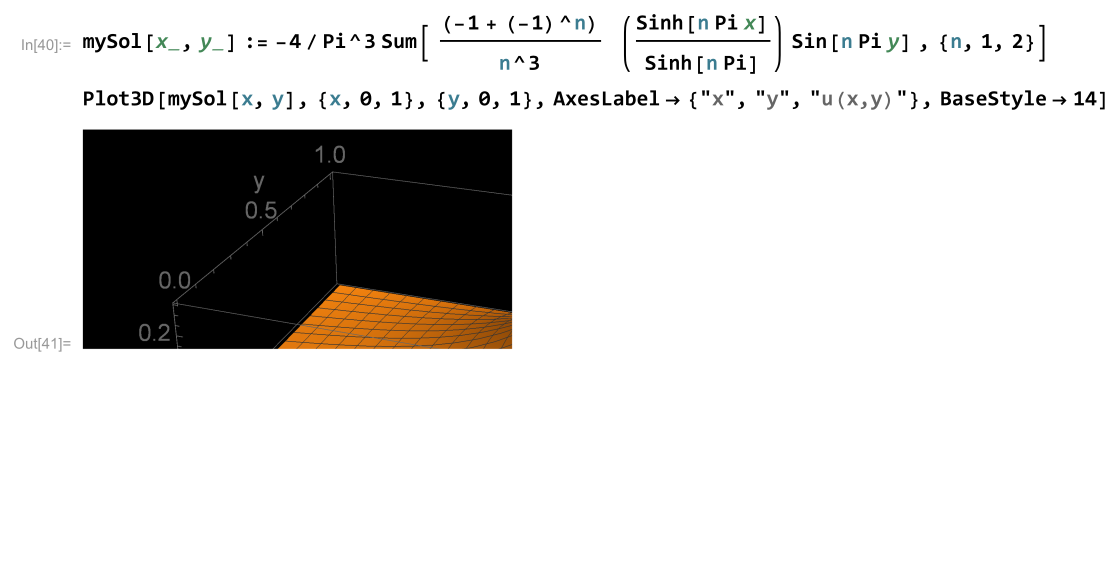
This is a 3D plot of the solution.
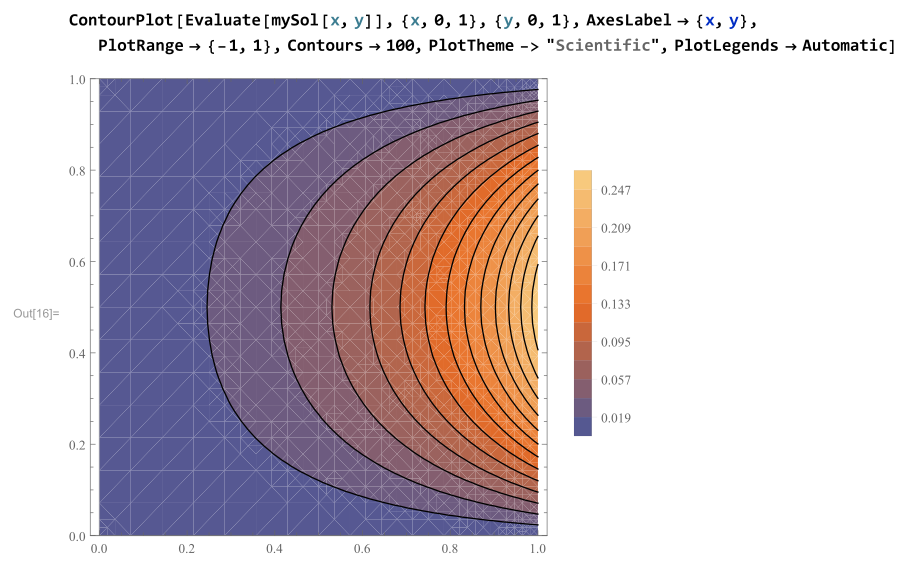
This is a contour plot
___________________________________________________________________________________________________________________________________________________________________________________________________________________________________________________________________________________________________________________________________________________________________________________________
4.1.1.3 problem number 282
Added Jan. 8, 2020.
This is Problem 6.3.10 from Introduction to Partial Differential Equations by Peter Olver ISBN 9783319020983.
Solve
\begin{align*} \nabla ^{2}u & =0\qquad \text {on a rectangle}\qquad R=\left \{ 0<x<a,0<y<b\right \} \\ u\left ( x,0\right ) & =f\left ( x\right ) \\ u\left ( x,b\right ) & =0\\ u\left ( 0,y\right ) & =0\\ u\left ( a,y\right ) & =0 \end{align*}
When the boundary data \(f\left ( x\right ) =\delta \left ( x-\xi \right ) \) is a delta function at a point \(0<\xi <a\) .
Mathematica ✓
ClearAll [ " Global ` * " ]; pde = Laplacian[u[x, y], {x, y}] == 0;
f [ x_ ] := DiracDelta [x - zeta];
bc = {u[x, 0] == f[x], u[x, b] == 0, u[0, y] == 0, u[a, y] == 0};
sol = AbsoluteTiming [ TimeConstrained [ DSolve [{pde, bc}, u[x, y], {x, y}, Assumptions -> {0 <= x <= a && 0 <= y <= b && 0 < zeta < a}], 60*10]];
sol = sol /. { K [1] -> n};
\[\left \{\left \{u(x,y)\to \underset {n=1}{\overset {\infty }{\sum }}\frac {2 \text {csch}\left (\frac {b n \pi }{a}\right ) \sin \left (\frac {n \pi x}{a}\right ) \sin \left (\frac {n \pi \zeta }{a}\right ) \sinh \left (\frac {n \pi (b-y)}{a}\right )}{a}\right \}\right \}\]
Maple ✓
restart ; interface ( showassumed =0); pde := diff ( u ( x , y ), x$2 )+ diff ( u ( x , y ), y$2 )=0; f := x -> Dirac ( x - zeta ); bc := u ( x ,0)= f ( x ), u(x, b) = 0, u(0,y) = 0,u(a,y)=0;
cpu_time := timelimit (60*10, CodeTools [ Usage ]( assign ( ' sol ' , pdsolve([pde,bc],u(x,y)) assuming (0<= x and x<=a and 0<=y and y<=b and 0<zeta and zeta<a)),output= ' realtime ' ));
\[u \left (x , y\right ) = 2 \left (\moverset {\infty }{\munderset {n =1}{\sum }}\frac {\operatorname {csch}\left (\frac {n \pi b}{a}\right ) \sin \left (\frac {n \pi x}{a}\right ) \sin \left (\frac {n \pi \zeta }{a}\right ) \sinh \left (\frac {\pi n \left (b -y \right )}{a}\right )}{a}\right )\]
Hand
solution
Let \(u\left ( x,y\right ) =X\left ( x\right ) Y\left ( x\right ) \) . Substituting this into the PDE \(\frac {\partial ^{2}u}{\partial x^{2}}+\frac {\partial ^{2}u}{\partial y^{2}}=0\) and simplifying gives
\[ \frac {X^{\prime \prime }}{X}=-\frac {Y^{\prime \prime }}{Y}\]
Each side depends on different independent variable and they are equal, therefore they must be equal to same constant.
\[ \frac {X^{\prime \prime }}{X}=-\frac {Y^{\prime \prime }}{Y}=\pm \lambda \]
Since the boundary conditions along the \(x\) direction are the homogeneous ones, \(-\lambda \) is selected in the above.
\[ \frac {X^{\prime \prime }}{X}=-\frac {Y^{\prime \prime }}{Y}=-\lambda \]
Two ODE’s are obtained
\begin{equation} X^{\prime \prime }+\lambda X=0 \tag {1}\end{equation}
\begin{align*} X\left ( 0\right ) & =0\\ X\left ( a\right ) & =0 \end{align*}
And
\begin{equation} Y^{\prime \prime }-\lambda Y=0 \tag {2}\end{equation}
\begin{align*} Y\left ( 0\right ) & =f\left ( x\right ) \\ Y\left ( b\right ) & =0 \end{align*}
In all these cases \(\lambda \) will turn out to be positive. This is shown below.
Case \(\lambda <0\)
The solution to (1) is
\[ X=A\cosh \left ( \sqrt {\left \vert \lambda \right \vert }x\right ) +B\sinh \left ( \sqrt {\left \vert \lambda \right \vert }x\right ) \]
At \(x=0\) , the above gives \(0=A\) . Hence \(X=B\sinh \left ( \sqrt {\left \vert \lambda \right \vert }x\right ) \) . At \(x=a\) this gives \(X=B\sinh \left ( \sqrt {\left \vert \lambda \right \vert }a\right ) \) . But \(\sinh \left ( \sqrt {\left \vert \lambda \right \vert }a\right ) =0\) only at \(0\) and \(\sqrt {\left \vert \lambda \right \vert }a\neq 0\) , therefore \(B=0\) and this leads to trivial solution. Hence \(\lambda <0\) is not an eigenvalue.
Case \(\lambda =0\)
\[ X=Ax+B \]
Hence at \(x=0\) this gives \(0=B\) and the solution becomes \(X=B\) . At \(x=a\) , \(B=0\) . Hence the trivial solution. \(\lambda =0\) is not an eigenvalue.
Case \(\lambda >0\)
Solution is
\[ X=A\cos \left ( \sqrt {\lambda }x\right ) +B\sin \left ( \sqrt {\lambda }x\right ) \]
At \(x=0\) this gives \(0=A\) and the solution becomes \(X=B\sin \left ( \sqrt {\lambda }x\right ) \) . At \(x=a\)
\[ 0=B\sin \left ( \sqrt {\lambda }a\right ) \]
For non-trivial solution \(\sin \left ( \sqrt {\lambda }a\right ) =0\) or \(\sqrt {\lambda }a=n\pi \) where \(n=1,2,3,\cdots \) , therefore
\[ \lambda _{n}=\left ( \frac {n\pi }{a}\right ) ^{2}\qquad n=1,2,3,\cdots \]
Eigenfunctions are
\begin{equation} X_{n}\left ( x\right ) =B_{n}\sin \left ( \frac {n\pi }{a}x\right ) \qquad n=1,2,3,\cdots \tag {3}\end{equation}
\(Y\) ODE, the solution is
\begin{equation} Y_{n}=C_{n}\cosh \left ( \frac {n\pi }{a}y\right ) +D_{n}\sinh \left ( \frac {n\pi }{a}y\right ) \tag {4}\end{equation}
\(y=b\) gives
\begin{align*} 0 & =C_{n}\cosh \left ( \frac {n\pi }{a}b\right ) +D_{n}\sinh \left ( \frac {n\pi }{a}b\right ) \\ C_{n} & =-D_{n}\frac {\sinh \left ( \frac {n\pi }{a}b\right ) }{\cosh \left ( \frac {n\pi }{a}b\right ) }\\ & =-D_{n}\tanh \left ( \frac {n\pi }{a}b\right ) \end{align*}
Hence (4) becomes
\begin{align*} Y_{n} & =-D_{n}\tanh \left ( \frac {n\pi }{a}b\right ) \cosh \left ( \frac {n\pi }{a}y\right ) +D_{n}\sinh \left ( \frac {n\pi }{a}y\right ) \\ & =D_{n}\left ( \sinh \left ( \frac {n\pi }{a}y\right ) -\tanh \left ( \frac {n\pi }{a}b\right ) \cosh \left ( \frac {n\pi }{a}y\right ) \right ) \end{align*}
Now the complete solution is produced
\begin{align*} u_{n}\left ( x,y\right ) & =Y_{n}X_{n}\\ & =D_{n}\left ( \sinh \left ( \frac {n\pi }{a}y\right ) -\tanh \left ( \frac {n\pi }{a}b\right ) \cosh \left ( \frac {n\pi }{a}y\right ) \right ) B_{n}\sin \left ( \frac {n\pi }{a}x\right ) \end{align*}
Let \(D_{n}B_{n}=B_{n}\) since a constant. (no need to make up a new symbol).
\[ u_{n}\left ( x,y\right ) =B_{n}\left ( \sinh \left ( \frac {n\pi }{a}y\right ) -\tanh \left ( \frac {n\pi }{a}b\right ) \cosh \left ( \frac {n\pi }{a}y\right ) \right ) \sin \left ( \frac {n\pi }{a}x\right ) \]
Sum of eigenfunctions is the solution, hence
\begin{equation} u\left ( x,y\right ) =\sum _{n=1}^{\infty }B_{n}\left ( \sinh \left ( \frac {n\pi }{a}y\right ) -\tanh \left ( \frac {n\pi }{a}b\right ) \cosh \left ( \frac {n\pi }{a}y\right ) \right ) \sin \left ( \frac {n\pi }{a}x\right ) \tag {5}\end{equation}
\(y=0\)
\[ u\left ( x,0\right ) =f\left ( x\right ) =\delta \left ( x-\xi \right ) \]
Therefore (5) becomes
\[ \delta \left ( x-\xi \right ) =\sum _{n=1}^{\infty }-B_{n}\tanh \left ( \frac {n\pi }{a}b\right ) \sin \left ( \frac {n\pi }{a}x\right ) \]
Multiplying both sides by \(\sin \left ( \frac {m\pi }{a}x\right ) \) and integrating gives
\begin{align*} \int _{0}^{a}\delta \left ( x-\xi \right ) \sin \left ( \frac {m\pi }{a}x\right ) dx & =-\int _{0}^{a}\sin \left ( \frac {m\pi }{a}x\right ) \sum _{n=1}^{\infty }B_{n}\tanh \left ( \frac {n\pi }{a}b\right ) \sin \left ( \frac {n\pi }{a}x\right ) dx\\ & =-\sum _{n=1}^{\infty }B_{n}\tanh \left ( \frac {n\pi }{a}b\right ) \int _{0}^{a}\sin \left ( \frac {n\pi }{a}x\right ) \sin \left ( \frac {m\pi }{a}x\right ) dx\\ & =-B_{n}\tanh \left ( \frac {m\pi }{a}b\right ) \left ( \frac {a}{2}\right ) \end{align*}
Hence
\[ B_{n}=-\frac {2}{a}\frac {\int _{0}^{a}\delta \left ( x-\xi \right ) \sin \left ( \frac {n\pi }{a}x\right ) dx}{\tanh \left ( \frac {n\pi }{a}b\right ) }\]
But \(\int _{0}^{a}\delta \left ( x-\xi \right ) \sin \left ( \frac {m\pi }{L}x\right ) dx=\sin \left ( \frac {m\pi }{L}\xi \right ) \) by the property delta function. Therefore
\[ B_{n}=-\frac {2}{a}\frac {\sin \left ( \frac {n\pi }{a}\xi \right ) }{\tanh \left ( \frac {n\pi }{a}b\right ) }\]
This completes the solution. (4) becomes
\begin{align*} u\left ( x,y\right ) & =-\frac {2}{a}\sum _{n=1}^{\infty }\frac {\sin \left ( \frac {n\pi }{a}\xi \right ) }{\tanh \left ( \frac {n\pi }{a}b\right ) }\left ( \sinh \left ( \frac {n\pi }{a}y\right ) -\tanh \left ( \frac {n\pi }{a}b\right ) \cosh \left ( \frac {n\pi }{a}y\right ) \right ) \sin \left ( \frac {n\pi }{a}x\right ) \\ & =-\frac {2}{a}\sum _{n=1}^{\infty }\sin \left ( \frac {n\pi }{a}\xi \right ) \sin \left ( \frac {n\pi }{a}x\right ) \left ( \frac {\sinh \left ( \frac {n\pi }{a}y\right ) }{\tanh \left ( \frac {n\pi }{a}b\right ) }-\cosh \left ( \frac {n\pi }{a}y\right ) \right ) \end{align*}
Looking at the solution above, it is composed of functions that are all differentiable. Hence the solution is infinitely differentiable inside the rectangle.
Here is a plot of the above solution using \(a=\pi ,b=\frac {1}{2},\xi =1\) .
___________________________________________________________________________________________________________________________________________________________________________________________________________________________________________________________________________________________________________________________________________________________________________________________
4.1.1.4 problem number 283
This is problem 2.5.1 part (a) from Richard Haberman applied partial differential equations, 5th edition
Solve Laplace equation
\[ \frac {\partial ^2 u}{\partial x^2} + \frac {\partial ^2 u}{\partial y^2} = 0 \]
inside a rectangle \(0 \leq x \leq L, 0 \leq y \leq H\) , with following boundary conditions
\begin{align*} \frac {\partial u}{\partial x}(0,y) &= 0 \\ \frac {\partial u}{\partial x}(L,y) &= 0 \\ u(x,0)&=0 \\ u(x,H)&=f(x) \\ \end{align*}
Mathematica ✓
ClearAll [ " Global ` * " ]; pde = D [u[x, y], {x, 2}] + D [u[x, y], {y, 2}] == 0;
bc = { Derivative [1, 0][u][0, y] == 0, Derivative [1, 0][u][L, y] == 0, u[x, 0] == 0, u[x, H] == f[x]};
sol = AbsoluteTiming [ TimeConstrained [ DSolve [{pde, bc}, u[x, y], {x, y}, Assumptions -> {0 <= x <= L && 0 <= y <= H}], 60*10]];
sol = sol /. { K [1] -> n};
\[\left \{\left \{u(x,y)\to \underset {n=1}{\overset {\infty }{\sum }}\frac {2 \cos \left (\frac {n \pi x}{L}\right ) \text {csch}\left (\frac {H n \pi }{L}\right ) \left (\int _0^L \cos \left (\frac {n \pi x}{L}\right ) f(x) \, dx\right ) \sinh \left (\frac {n \pi y}{L}\right )}{L}+\frac {y \int _0^L f(x) \, dx}{H L}\right \}\right \}\]
Maple ✓
restart ; interface ( showassumed =0); pde := diff ( u ( x , y ), x$2 )+ diff ( u ( x , y ), y$2 )=0; assume ( L >0 and H>0);
bc := D [1]( u )(0, y )=0, D [1]( u )( L , y )=0, u ( x ,0)=0, u ( x , H )= f ( x ); cpu_time := timelimit (60*10, CodeTools [ Usage ]( assign ( ' sol ' , pdsolve([pde,bc],u(x,y)) assuming (0<= x and x<=L and 0<=y and y<=H)),output= ' realtime ' ));
# these simplifications below to convert answer to one that match standard;
sol := convert ( sol , trigh ); sol := simplify ( expand ( sol )); \[u \left (x , y\right ) = \frac {\frac {y \int _{0}^{L}f \left (x \right )d x}{H}+2 \left (\moverset {\infty }{\munderset {n =1}{\sum }}\cos \left (\frac {n \pi x}{L}\right ) \int _{0}^{L}f \left (x \right ) \cos \left (\frac {n \pi x}{L}\right )d x \operatorname {csch}\left (\frac {n \pi H}{L}\right ) \sinh \left (\frac {n \pi y}{L}\right )\right )}{L}\]
___________________________________________________________________________________________________________________________________________________________________________________________________________________________________________________________________________________________________________________________________________________________________________________________
4.1.1.5 problem number 284
This is problem 2.5.1 part (b) from Richard Haberman applied partial differential equations, 5th edition
Solve Laplace equation
\[ \frac {\partial ^2 u}{\partial x^2} + \frac {\partial ^2 u}{\partial y^2} = 0 \]
inside a rectangle \(0 \leq x \leq L, 0 \leq y \leq H\) , with following boundary conditions
\begin{align*} \frac {\partial u}{\partial x}(0,y) &= g(y) \\ \frac {\partial u}{\partial x}(L,y) &= 0 \\ u(x,0)&=0 \\ u(x,H)&=0 \\ \end{align*}
Mathematica ✓
ClearAll [ " Global ` * " ]; pde = D [u[x, y], {x, 2}] + D [u[x, y], {y, 2}] == 0;
bc = { Derivative [1, 0][u][0, y] == g[y], Derivative [1, 0][u][L, y] == 0, u[x, 0] == 0, u[x, H] == 0};
sol = AbsoluteTiming [ TimeConstrained [ DSolve [{pde, bc}, u[x, y], {x, y}, Assumptions -> {0 <= x <= L && 0 <= y <= H}], 60*10]];
sol = sol /. { K [1] -> n};
\[\left \{\left \{u(x,y)\to \underset {n=1}{\overset {\infty }{\sum }}-\frac {2 \cosh \left (\frac {n \pi (L-x)}{H}\right ) \text {csch}\left (\frac {L n \pi }{H}\right ) \left (\int _0^H g(y) \sin \left (\frac {n \pi y}{H}\right ) \, dy\right ) \sin \left (\frac {n \pi y}{H}\right )}{n \pi }\right \}\right \}\]
Maple ✓
restart ; interface ( showassumed =0); pde := diff ( u ( x , y ), x$2 )+ diff ( u ( x , y ), y$2 )=0; assume ( L >0 and H>0):
bc := D [1]( u )(0, y )= g ( y ), D [1]( u )( L , y )=0, u ( x ,0)=0, u ( x , H )=0: cpu_time := timelimit (60*10, CodeTools [ Usage ]( assign ( ' sol ' , pdsolve([pde,bc],u(x,y)) assuming (0<= x and x<=L and 0<=y and y<=H)),output= ' realtime ' ));
sol := convert ( sol , trigh ); \[u \left (x , y\right ) = -\frac {2 \left (\moverset {\infty }{\munderset {n =1}{\sum }}\frac {\sin \left (\frac {n \pi y}{H}\right ) \int _{0}^{H}\sin \left (\frac {n \pi y}{H}\right ) g \left (y \right )d y \operatorname {csch}\left (\frac {n \pi L}{H}\right ) \cosh \left (\frac {\pi n \left (L -x \right )}{H}\right )}{n}\right )}{\pi }\]
___________________________________________________________________________________________________________________________________________________________________________________________________________________________________________________________________________________________________________________________________________________________________________________________
4.1.1.6 problem number 285
This is problem 2.5.1 part (c) from Richard Haberman applied partial differential equations, 5th edition
Solve Laplace equation
\[ \frac {\partial ^2 u}{\partial x^2} + \frac {\partial ^2 u}{\partial y^2} = 0 \]
inside a rectangle \(0 \leq x \leq L, 0 \leq y \leq H\) , with following boundary conditions
\begin{align*} \frac {\partial u}{\partial x}(0,y) &= 0 \\ u(L,y) &= g(y) \\ u(x,0)&=0 \\ u(x,H)&=0 \\ \end{align*}
Mathematica ✓
ClearAll [ " Global ` * " ]; pde = D [u[x, y], {x, 2}] + D [u[x, y], {y, 2}] == 0;
bc = { Derivative [1, 0][u][0, y] == 0, u[L, y] == g[y], u[x, 0] == 0, u[x, H] == 0};
sol = AbsoluteTiming [ TimeConstrained [ DSolve [{pde, bc}, u[x, y], {x, y}, Assumptions -> {0 <= x <= L && 0 <= y <= H}], 60*10]];
\[\left \{\left \{u(x,y)\to \underset {K[1]=1}{\overset {\infty }{\sum }}\sqrt {2} \sqrt {\frac {1}{H}} \cosh \left (\frac {\pi x K[1]}{H}\right ) \left (\int _0^H \frac {\sqrt {2} g(y) \sin \left (\frac {\pi y K[1]}{H}\right )}{\sqrt {H}} \, dy\right ) \text {sech}\left (\frac {L \pi K[1]}{H}\right ) \sin \left (\frac {\pi y K[1]}{H}\right )\right \}\right \}\]
Maple ✓
restart ; interface ( showassumed =0); pde := diff ( u ( x , y ), x$2 )+ diff ( u ( x , y ), y$2 )=0; assume ( L >0 and H>0);
bc := D [1]( u )(0, y )=0, u ( L , y )= g ( y ), u ( x ,0)=0, u ( x , H )=0; cpu_time := timelimit (60*10, CodeTools [ Usage ]( assign ( ' sol ' , pdsolve([pde,bc],u(x,y)) assuming (0<= x and x<=L and 0<=y and y<=H)),output= ' realtime ' ));
sol := convert ( sol , trigh ); \[u \left (x , y\right ) = \frac {2 \left (\moverset {\infty }{\munderset {n =1}{\sum }}\sin \left (\frac {n \pi y}{H}\right ) \int _{0}^{H}\sin \left (\frac {n \pi y}{H}\right ) g \left (y \right )d y \operatorname {sech}\left (\frac {n \pi L}{H}\right ) \cosh \left (\frac {n \pi x}{H}\right )\right )}{H}\]
___________________________________________________________________________________________________________________________________________________________________________________________________________________________________________________________________________________________________________________________________________________________________________________________
4.1.1.7 problem number 286
This is problem 2.5.1 part (d) from Richard Haberman applied partial differential equations, 5th edition
Solve Laplace equation
\[ \frac {\partial ^2 u}{\partial x^2} + \frac {\partial ^2 u}{\partial y^2} = 0 \]
inside a rectangle \(0 \leq x \leq L, 0 \leq y \leq H\) , with following boundary conditions
\begin{align*} u(0,y) &= g(y) \\ u(L,y) &= 0 \\ \frac {\partial u}{\partial y}u(x,0)&=0 \\ u(x,H)&=0 \\ \end{align*}
Mathematica ✓
ClearAll [ " Global ` * " ]; pde = D [u[x, y], {x, 2}] + D [u[x, y], {y, 2}] == 0;
bc = {u[0, y] == g[y], u[L, y] == 0, Derivative [0, 1][u][x, 0] == 0, u[x, H] == 0};
sol = AbsoluteTiming [ TimeConstrained [ DSolve [{pde, bc}, u[x, y], {x, y}, Assumptions -> {0 <= x <= L && 0 <= y <= H}], 60*10]];
sol = sol/. K [1]->n;
\[\left \{\left \{u(x,y)\to \underset {n=1}{\overset {\infty }{\sum }}\frac {\sqrt {2} \cos \left (\frac {(2 n-1) \pi y}{2 H}\right ) \text {csch}\left (\frac {L (2 n-1) \pi }{2 H}\right ) \left (\int _0^H \frac {\sqrt {2} \cos \left (\frac {(2 n-1) \pi y}{2 H}\right ) g(y)}{\sqrt {H}} \, dy\right ) \sinh \left (\frac {(2 n-1) \pi (L-x)}{2 H}\right )}{\sqrt {H}}\right \}\right \}\]
Maple ✓
restart ; interface ( showassumed =0); pde := diff ( u ( x , y ), x$2 )+ diff ( u ( x , y ), y$2 )=0; assume ( L >0 and H>0);
bc := u(0,y)=g(y),u(L,y)=0, D [2]( u )( x ,0)=0, u ( x , H )=0; cpu_time := timelimit (60*10, CodeTools [ Usage ]( assign ( ' sol ' , pdsolve ([ pde , bc ], u ( x , y )) assuming (0<= x and x<=L and 0<=y and y<=H)),output= ' realtime ' ));
sol := convert ( sol , trigh ); \[u \left (x , y\right ) = \frac {2 \left (\moverset {\infty }{\munderset {n =0}{\sum }}\left (-\cos \left (\frac {\left (1+2 n \right ) \pi y}{2 H}\right ) \int _{0}^{H}\cos \left (\frac {\left (1+2 n \right ) \pi y}{2 H}\right ) g \left (y \right )d y \sinh \left (\frac {\left (-L +x \right ) \left (\frac {1}{2}+n \right ) \pi }{H}\right ) \operatorname {csch}\left (\frac {\left (1+2 n \right ) \pi L}{2 H}\right )\right )\right )}{H}\]
___________________________________________________________________________________________________________________________________________________________________________________________________________________________________________________________________________________________________________________________________________________________________________________________
4.1.1.8 problem number 287
This is problem 2.5.1 part (e) from Richard Haberman applied partial differential equations, 5th edition
Solve Laplace equation
\[ \frac {\partial ^2 u}{\partial x^2} + \frac {\partial ^2 u}{\partial y^2} = 0 \]
inside a rectangle \(0 \leq x \leq L, 0 \leq y \leq H\) , with following boundary conditions
\begin{align*} u(0,y) &= 0 \\ u(L,y) &= 0 \\ u(x,0) - \frac {\partial u}{\partial y}u(x,0)&=0 \\ u(x,H)&= f(x) \\ \end{align*}
Mathematica ✓
ClearAll [ " Global ` * " ]; pde = D [u[x, y], {x, 2}] + D [u[x, y], {y, 2}] == 0;
bc = {u[0, y] == 0, u[L, y] == 0, u[x, 0] - Derivative [0, 1][u][x, 0] == 0, u[x, H] == f[x]};
sol = AbsoluteTiming [ TimeConstrained [ DSolve [{pde, bc}, u[x, y], {x, y}, Assumptions -> {0 <= x <= L && 0 <= y <= H}], 60*10]];
sol = sol/. K [1]->n;
\[\left \{\left \{u(x,y)\to \underset {n=1}{\overset {\infty }{\sum }}\frac {\sqrt {2} \sqrt {\frac {1}{L}} \left (\int _0^L \frac {\sqrt {2} f(x) \sin \left (\frac {n \pi x}{L}\right )}{\sqrt {L}} \, dx\right ) \sin \left (\frac {n \pi x}{L}\right ) \left (n \pi \cosh \left (\frac {n \pi y}{L}\right )+L \sinh \left (\frac {n \pi y}{L}\right )\right )}{n \pi \cosh \left (\frac {H n \pi }{L}\right )+L \sinh \left (\frac {H n \pi }{L}\right )}\right \}\right \}\]
Maple ✓
restart ; interface ( showassumed =0); pde := diff ( u ( x , y ), x$2 )+ diff ( u ( x , y ), y$2 )=0; assume ( L >0 and H>0);
bc := u(0,y)=0,u(L,y)=0,u(x,0)- D [2]( u )( x ,0)=0, u ( x , H )= f ( x ); cpu_time := timelimit (60*10, CodeTools [ Usage ]( assign ( ' sol ' , pdsolve ([ pde , bc ], u ( x , y )) assuming (0<= x and x<=L and 0<=y and y<=H)),output= ' realtime ' ));
sol := convert ( sol , trigh ); \[u \left (x , y\right ) = \frac {2 \left (\moverset {\infty }{\munderset {n =1}{\sum }}\frac {\sin \left (\frac {n \pi x}{L}\right ) \int _{0}^{L}\sin \left (\frac {n \pi x}{L}\right ) f \left (x \right )d x \left (\pi n \cosh \left (\frac {n \pi y}{L}\right )+L \sinh \left (\frac {n \pi y}{L}\right )\right )}{\pi n \cosh \left (\frac {n \pi H}{L}\right )+L \sinh \left (\frac {n \pi H}{L}\right )}\right )}{L}\]
Hand
solution
Let \(u\left ( x,y\right ) =X\left ( x\right ) Y\left ( x\right ) \) . Substituting this into the PDE \(\frac {\partial ^{2}u}{\partial x^{2}}+\frac {\partial ^{2}u}{\partial y^{2}}=0\) and simplifying gives
\[ \frac {X^{\prime \prime }}{X}=-\frac {Y^{\prime \prime }}{Y}\]
Each side depends on different independent variable and they are equal, therefore they must be equal to same constant.
\[ \frac {X^{\prime \prime }}{X}=-\frac {Y^{\prime \prime }}{Y}=\pm \lambda \]
Since the boundary conditions along the \(x\) direction are the homogeneous ones, \(-\lambda \) is selected in the above. Two ODE’s (1,2) are obtained as follows
\begin{equation} X^{\prime \prime }+\lambda X=0 \tag {1}\end{equation}
\begin{align*} X\left ( 0\right ) & =0\\ X\left ( L\right ) & =0 \end{align*}
And
\begin{equation} Y^{\prime \prime }-\lambda Y=0 \tag {2}\end{equation}
\begin{align*} Y\left ( 0\right ) & =Y^{\prime }\left ( 0\right ) \\ Y\left ( H\right ) & =f\left ( x\right ) \end{align*}
In all these cases \(\lambda \) will turn out to be positive. This is shown for this problem only and not be repeated again.
Case \(\lambda <0\)
The solution to (1) us
\[ X=A\cosh \left ( \sqrt {\left \vert \lambda \right \vert }x\right ) +B\sinh \left ( \sqrt {\left \vert \lambda \right \vert }x\right ) \]
At \(x=0\) , the above gives \(0=A\) . Hence \(X=B\sinh \left ( \sqrt {\left \vert \lambda \right \vert }x\right ) \) . At \(x=L\) this gives \(X=B\sinh \left ( \sqrt {\left \vert \lambda \right \vert }L\right ) \) . But \(\sinh \left ( \sqrt {\left \vert \lambda \right \vert }L\right ) =0\) only at \(0\) and \(\sqrt {\left \vert \lambda \right \vert }L\neq 0\) , therefore \(B=0\) and this leads to trivial solution. Hence \(\lambda <0\) is not an eigenvalue.
Case \(\lambda =0\)
\[ X=Ax+B \]
Hence at \(x=0\) this gives \(0=B\) and the solution becomes \(X=B\) . At \(x=L\) , \(B=0\) . Hence the trivial solution. \(\lambda =0\) is not an eigenvalue.
Case \(\lambda >0\)
Solution is
\[ X=A\cos \left ( \sqrt {\lambda }x\right ) +B\sin \left ( \sqrt {\lambda }x\right ) \]
At \(x=0\) this gives \(0=A\) and the solution becomes \(X=B\sin \left ( \sqrt {\lambda }x\right ) \) . At \(x=L\)
\[ 0=B\sin \left ( \sqrt {\lambda }L\right ) \]
For non-trivial solution \(\sin \left ( \sqrt {\lambda }L\right ) =0\) or \(\sqrt {\lambda }L=n\pi \) where \(n=1,2,3,\cdots \) , therefore
\[ \lambda _{n}=\left ( \frac {n\pi }{L}\right ) ^{2}\qquad n=1,2,3,\cdots \]
Eigenfunctions are
\begin{equation} X_{n}\left ( x\right ) =B_{n}\sin \left ( \frac {n\pi }{L}x\right ) \qquad n=1,2,3,\cdots \tag {3}\end{equation}
\(Y\) ODE, the solution is
\begin{align*} Y_{n} & =C_{n}\cosh \left ( \frac {n\pi }{L}y\right ) +D_{n}\sinh \left ( \frac {n\pi }{L}y\right ) \\ Y_{n}^{\prime } & =C_{n}\frac {n\pi }{L}\sinh \left ( \frac {n\pi }{L}y\right ) +D_{n}\frac {n\pi }{L}\cosh \left ( \frac {n\pi }{L}y\right ) \end{align*}
Applying B.C. at \(y=0\) gives
\begin{align*} Y\left ( 0\right ) & =Y^{\prime }\left ( 0\right ) \\ C_{n}\cosh \left ( 0\right ) & =D_{n}\frac {n\pi }{L}\cosh \left ( 0\right ) \\ C_{n} & =D_{n}\frac {n\pi }{L}\end{align*}
The eigenfunctions \(Y_{n}\) are
\begin{align*} Y_{n} & =D_{n}\frac {n\pi }{L}\cosh \left ( \frac {n\pi }{L}y\right ) +D_{n}\sinh \left ( \frac {n\pi }{L}y\right ) \\ & =D_{n}\left ( \frac {n\pi }{L}\cosh \left ( \frac {n\pi }{L}y\right ) +\sinh \left ( \frac {n\pi }{L}y\right ) \right ) \end{align*}
Now the complete solution is produced
\begin{align*} u_{n}\left ( x,y\right ) & =Y_{n}X_{n}\\ & =D_{n}\left ( \frac {n\pi }{L}\cosh \left ( \frac {n\pi }{L}y\right ) +\sinh \left ( \frac {n\pi }{L}y\right ) \right ) B_{n}\sin \left ( \frac {n\pi }{L}x\right ) \end{align*}
Let \(D_{n}B_{n}=B_{n}\) since a constant. (no need to make up a new symbol).
\[ u_{n}\left ( x,y\right ) =B_{n}\left ( \frac {n\pi }{L}\cosh \left ( \frac {n\pi }{L}y\right ) +\sinh \left ( \frac {n\pi }{L}y\right ) \right ) \sin \left ( \frac {n\pi }{L}x\right ) \]
Sum of eigenfunctions is the solution, hence
\[ u\left ( x,y\right ) =\sum _{n=1}^{\infty }B_{n}\left ( \frac {n\pi }{L}\cosh \left ( \frac {n\pi }{L}y\right ) +\sinh \left ( \frac {n\pi }{L}y\right ) \right ) \sin \left ( \frac {n\pi }{L}x\right ) \]
The nonhomogeneous boundary condition is now resolved. At \(y=H\)
\[ u\left ( x,H\right ) =f\left ( x\right ) \]
Therefore
\[ f\left ( x\right ) =\sum _{n=1}^{\infty }B_{n}\left ( \frac {n\pi }{L}\cosh \left ( \frac {n\pi }{L}H\right ) +\sinh \left ( \frac {n\pi }{L}H\right ) \right ) \sin \left ( \frac {n\pi }{L}x\right ) \]
Multiplying both sides by \(\sin \left ( \frac {m\pi }{L}x\right ) \) and integrating gives
\begin{align*} \int _{0}^{L}f\left ( x\right ) \sin \left ( \frac {m\pi }{L}x\right ) dx & =\int _{0}^{L}\sin \left ( \frac {m\pi }{L}x\right ) \sum _{n=1}^{\infty }B_{n}\left ( \frac {n\pi }{L}\cosh \left ( \frac {n\pi }{L}H\right ) +\sinh \left ( \frac {n\pi }{L}H\right ) \right ) \sin \left ( \frac {n\pi }{L}x\right ) dx\\ & =\sum _{n=1}^{\infty }B_{n}\left ( \frac {n\pi }{L}\cosh \left ( \frac {n\pi }{L}H\right ) +\sinh \left ( \frac {n\pi }{L}H\right ) \right ) \int _{0}^{L}\sin \left ( \frac {n\pi }{L}x\right ) \sin \left ( \frac {m\pi }{L}x\right ) dx\\ & =B_{m}\left ( \frac {m\pi }{L}\cosh \left ( \frac {m\pi }{L}H\right ) +\sinh \left ( \frac {m\pi }{L}H\right ) \right ) \frac {L}{2}\end{align*}
Hence
\begin{equation} B_{n}=\frac {2}{L}\frac {\int _{0}^{L}f\left ( x\right ) \sin \left ( \frac {n\pi }{L}x\right ) dx}{\left ( \frac {n\pi }{L}\cosh \left ( \frac {n\pi }{L}H\right ) +\sinh \left ( \frac {n\pi }{L}H\right ) \right ) } \tag {4}\end{equation}
summary
\[ u\left ( x,y\right ) =\sum _{n=1}^{\infty }B_{n}\left ( \frac {n\pi }{L}\cosh \left ( \frac {n\pi }{L}y\right ) +\sinh \left ( \frac {n\pi }{L}y\right ) \right ) \sin \left ( \frac {n\pi }{L}x\right ) \]
With \(B_{n}\) given by (4).
___________________________________________________________________________________________________________________________________________________________________________________________________________________________________________________________________________________________________________________________________________________________________________________________
4.1.1.9 problem number 288
Taken from Mathematica DSolve help pages.
Solve Laplace equation
\[ \frac {\partial ^2 u}{\partial x^2} + \frac {\partial ^2 u}{\partial y^2} = 0 \]
inside a rectangle \(0 \leq x \leq 1, 0 \leq y \leq 2\) , with following boundary conditions
\begin{align*} u(0,y) &= 0 \\ u(1,y) &= 0 \\ u(x,0) &= \text {UnitTriagle(2 x-1)} \\ u(x,2) &= \text {UnitTriagle(2 x-1)} \end{align*}
Mathematica ✓
ClearAll [ " Global ` * " ]; pde = Laplacian[u[x, y], {x, y}] == 0;
L0 = 1;
H0 = 2;
bc = DirichletCondition[u[x, y] == Piecewise [{{UnitTriangle[2*x - L0], y == 0 || y == H0}}, 0], True ];
domain = Rectangle [{0, 0}, {L0, H0}];
sol = AbsoluteTiming [ TimeConstrained [ Simplify [ DSolve [{pde, bc}, u[x, y], Element [{x, y}, domain]]], 60*10]];
sol = sol /. K [1] -> n;
\[\left \{\left \{u(x,y)\to \underset {n=1}{\overset {\infty }{\sum }}\frac {8 \text {csch}(2 n \pi ) \sin \left (\frac {n \pi }{2}\right ) \sin (n \pi x) (\sinh (n \pi (2-y))+\sinh (n \pi y))}{n^2 \pi ^2}\right \}\right \}\]
Maple ✓
restart ; interface ( showassumed =0); pde := diff ( u ( x , y ), x$2 )+ diff ( u ( x , y ), y$2 )=0; f := x -> piecewise ( x >0 and x<1/2, 2*x, x>1/2 and x<1, 2-2*x);
bc := u(0,y)=0,u(1,y)=0,u(x,0)=f(x),u(x,2)=f(x);
cpu_time := timelimit (60*10, CodeTools [ Usage ]( assign ( ' sol ' , pdsolve ([ pde , bc ], u ( x , y )) assuming x>0,y>0),output= ' realtime ' ));
\[u \left (x , y\right ) = \frac {8 \left (\moverset {\infty }{\munderset {n =1}{\sum }}\frac {\sin \left (n \pi x \right ) \sin \left (\frac {n \pi }{2}\right ) \cosh \left (n \pi \left (-1+y \right )\right ) \operatorname {sech}\left (n \pi \right )}{n^{2}}\right )}{\pi ^{2}}\]
___________________________________________________________________________________________________________________________________________________________________________________________________________________________________________________________________________________________________________________________________________________________________________________________
4.1.1.10 problem number 289
Added December 20, 2018.
Example 21, Taken from https://www.mapleprimes.com/posts/209970-Exact-Solutions-For-PDE-And-Boundary--Initial-Conditions-2018
Solve Laplace equation
\[ u_{xx}+u_{yy} = 0 \]
Inside a rectangle \(0 \leq x \leq L, 0 \leq y \leq \infty \) , with following boundary conditions
\begin{align*} u(0,y) &= A \\ u(L,y) &= 0 \\ u(x,0) &= 0 \end{align*}
Mathematica ✓
ClearAll [ " Global ` * " ]; pde = Laplacian[u[x, y], {x, y}] == 0;
bc = {u[0, y] == A, u[L, y] == 0, u[x, 0] == 0};
sol = AbsoluteTiming [ TimeConstrained [ Simplify [ DSolve [{pde, bc}, u[x, y], {x, y}, Assumptions -> {x > 0, y > 0, L > 0}]], 60*10]];
\[\left \{\left \{u(x,y)\to \frac {A \left (-i L \log \left (1-e^{\frac {i \pi (x+i y)}{L}}\right )+i L \log \left (1-e^{-\frac {\pi (y+i x)}{L}}\right )+\pi (L-x)\right )}{\pi L}\right \}\right \}\]
Maple ✓
restart ; pde := diff ( u ( x , y), x$2)+ diff ( u ( x , y), y$2) = 0;
bc_left_edge := u(0, y) = A;
bc_right_edge := u(L, y) = 0;
bc_bottom_edge := u(x, 0) = 0;
bc := bc_left_edge ,bc_right_edge,bc_bottom_edge;
cpu_time := timelimit (60*10, CodeTools [ Usage ]( assign ( ' sol ' , pdsolve ([ pde , bc], HINT = boundedseries(y = infinity )) assuming x>0,y>0,L>0),output= ' realtime ' ));
\[u \left (x , y\right ) = \frac {A \left (L -x \right )}{L}-\frac {2 \left (\moverset {\infty }{\munderset {n =1}{\sum }}\frac {\sin \left (\frac {n \pi x}{L}\right ) {\mathrm e}^{-\frac {n \pi y}{L}} A}{n}\right )}{\pi }\]
Hand
solution
Let
\begin{equation} u=U+v\tag {1}\end{equation}
\(U\) satisfies \(\nabla ^{2}U=0\) but with right edge boundary conditions zero, and \(v\left ( x\right ) \) satisfies the nonhomogeneous boundary conditions \(v\left ( 0\right ) =A,v\left ( L\right ) =0\) . This implies
\[ v\left ( x\right ) =A\left ( 1-\frac {x}{L}\right ) \]
Hence \(u=U+A\left ( 1-\frac {x}{L}\right ) \) . Substituting this back in \(\nabla ^{2}u=0\) gives
\[ \nabla ^{2}U=0 \]
But with boundary condition on right edge being zero now. Let \(U=X\left ( x\right ) Y\left ( x\right ) \) . Substituting this in the above gives
\[ \frac {X^{\prime \prime }}{X}+\frac {Y^{\prime \prime }}{Y}=0 \]
We want the eigenvalue problem to be in the \(X\) direction. Hence
\begin{align*} X^{\prime \prime }+\lambda X & =0\\ X\left ( 0\right ) & =0\\ X\left ( L\right ) & =0 \end{align*}
This has eigenvalues \(\lambda _{n}=\left ( \frac {n\pi }{L}\right ) ^{2},n=1,2,\cdots \) with eigenfunctions \(X_{n}\left ( x\right ) =\sin \left ( \sqrt {\lambda _{n}}x\right ) \) . The \(Y\) ode is
\begin{align*} Y_{n}^{\prime \prime }-\lambda _{n}Y_{n} & =0\\ Y_{n}\left ( 0\right ) & =0 \end{align*}
Since \(\lambda _{n}>0\) then the solution is \(Y_{n}\left ( y\right ) =c_{1_{n}}e^{\sqrt {\lambda _{n}}y}+c_{2_{n}}e^{-\sqrt {\lambda _{n}}y}\) . Since \(Y_{n}\left ( y\right ) \) is bounded, then \(c_{1_{n}}=0\) and the \(Y_{n}\left ( y\right ) =c_{2_{n}}e^{-\sqrt {\lambda _{n}}y}\) . Hence
\begin{align*} U\left ( x,y\right ) & =\sum _{n=1}^{\infty }X_{n}\left ( x\right ) Y_{n}\left ( y\right ) \\ & =\sum _{n=1}^{\infty }B_{n}\sin \left ( \sqrt {\lambda _{n}}x\right ) e^{-\sqrt {\lambda _{n}}y}\\ & =\sum _{n=1}^{\infty }B_{n}\sin \left ( \frac {n\pi }{L}x\right ) e^{-\frac {n\pi }{L}y}\end{align*}
Using the above in (1) gives the solution
\begin{equation} u\left ( x,y\right ) =A\left ( 1-\frac {x}{L}\right ) +\sum _{n=1}^{\infty }B_{n}\sin \left ( \frac {n\pi }{L}x\right ) e^{-\frac {n\pi }{L}y}\tag {2}\end{equation}
\(y=0\) the above gives
\begin{align*} 0 & =A\left ( 1-\frac {x}{L}\right ) +\sum _{n=1}^{\infty }B_{n}\sin \left ( \frac {n\pi }{L}x\right ) \\ A\left ( \frac {x}{L}-1\right ) & =\sum _{n=1}^{\infty }B_{n}\sin \left ( \frac {n\pi }{L}x\right ) \end{align*}
Therefore \(B_{n}\) are the Fourier sine coefficients of \(\frac {A}{L}x\)
\begin{align*} B_{n} & =\frac {2}{L}\int _{0}^{L}A\left ( \frac {x}{L}-1\right ) \sin \left ( \frac {n\pi }{L}x\right ) dx\\ & =\frac {2A}{L}\int _{0}^{L}\left ( \frac {x}{L}-1\right ) \sin \left ( \frac {n\pi }{L}x\right ) dx\\ & =-\frac {2A}{L}\frac {L}{n\pi }\\ & =-\frac {2A}{n\pi }\end{align*}
Hence the solution (2) becomes
\[ u\left ( x,y\right ) =A\left ( 1-\frac {x}{L}\right ) -2\frac {A}{\pi }\sum _{n=1}^{\infty }\frac {1}{n}\sin \left ( \frac {n\pi }{L}x\right ) e^{-\frac {n\pi }{L}y}\]
___________________________________________________________________________________________________________________________________________________________________________________________________________________________________________________________________________________________________________________________________________________________________________________________
4.1.1.11 problem number 290
Added March 19, 2019
Solve Laplace equation
\[ u_{xx} + u_{yy} = 0 \]
Inside a rectangle \(0 \leq x \leq L, 0 \leq y \leq \infty \) , with following boundary conditions
\begin{align*} u(0,y) &= 0 \\ u(L,y) &= A \\ u(x,0) &= 0 \end{align*}
Mathematica ✓
ClearAll [ " Global ` * " ]; pde = Laplacian[u[x, y], {x, y}] == 0;
bc = {u[0, y] == 0, u[L, y] == A, u[x, 0] == 0};
sol = AbsoluteTiming [ TimeConstrained [ Simplify [ DSolve [{pde, bc}, u[x, y], {x, y}, Assumptions -> {x > 0, y > 0, L > 0}]], 60*10]];
\[\left \{\left \{u(x,y)\to \frac {A \left (i L \log \left (1+e^{\frac {i \pi (x+i y)}{L}}\right )-i L \log \left (1+e^{-\frac {\pi (y+i x)}{L}}\right )+\pi x\right )}{\pi L}\right \}\right \}\]
Maple ✓
restart ; pde := diff ( u ( x , y), x$2)+ diff ( u ( x , y), y$2) = 0;
bc_left_edge := u(0, y) = 0;
bc_right_edge := u(L, y) = A;
bc_bottom_edge := u(x, 0) = 0;
bc := bc_left_edge ,bc_right_edge,bc_bottom_edge;
cpu_time := timelimit (60*10, CodeTools [ Usage ]( assign ( ' sol ' , pdsolve ([ pde , bc], HINT = boundedseries(y = infinity )) assuming x>0,y>0,L>0),output= ' realtime ' ));
\[u \left (x , y\right ) = \frac {A x}{L}+\frac {2 \left (\moverset {\infty }{\munderset {n =1}{\sum }}\frac {\left (-1\right )^{n} \sin \left (\frac {n \pi x}{L}\right ) {\mathrm e}^{-\frac {n \pi y}{L}} A}{n}\right )}{\pi }\]
Hand
solution
Let
\begin{equation} u=U+v\tag {1}\end{equation}
\(U\) satisfies \(\nabla ^{2}U=0\) but with right edge boundary conditions zero, and \(v\left ( x\right ) \) satisfies the nonhomogeneous boundary conditions \(v\left ( 0\right ) =0A,v\left ( L\right ) =A\) . This implies
\[ v\left ( x\right ) =A\frac {x}{L}\]
Hence \(u=U+\frac {A}{L}x\) . Substituting this back in \(\nabla ^{2}u=0\) gives
\[ \nabla ^{2}U=0 \]
But with boundary condition on right edge being zero now. Let \(U=X\left ( x\right ) Y\left ( x\right ) \) . Substituting this in the above gives
\[ \frac {X^{\prime \prime }}{X}+\frac {Y^{\prime \prime }}{Y}=0 \]
We want the eigenvalue problem to be in the \(X\) direction. Hence
\begin{align*} X^{\prime \prime }+\lambda X & =0\\ X\left ( 0\right ) & =0\\ X\left ( L\right ) & =0 \end{align*}
This has eigenvalues \(\lambda _{n}=\left ( \frac {n\pi }{L}\right ) ^{2},n=1,2,\cdots \) with eigenfunctions \(X_{n}\left ( x\right ) =\sin \left ( \sqrt {\lambda _{n}}x\right ) \) . The \(Y\) ode is
\begin{align*} Y_{n}^{\prime \prime }-\lambda _{n}Y_{n} & =0\\ Y_{n}\left ( 0\right ) & =0 \end{align*}
Since \(\lambda _{n}>0\) then the solution is \(Y_{n}\left ( y\right ) =c_{1_{n}}e^{\sqrt {\lambda _{n}}y}+c_{2_{n}}e^{-\sqrt {\lambda _{n}}y}\) . Since \(Y_{n}\left ( y\right ) \) is bounded, then \(c_{1_{n}}=0\) and the \(Y_{n}\left ( y\right ) =c_{2_{n}}e^{-\sqrt {\lambda _{n}}y}\) . Hence
\begin{align*} U\left ( x,y\right ) & =\sum _{n=1}^{\infty }X_{n}\left ( x\right ) Y_{n}\left ( y\right ) \\ & =\sum _{n=1}^{\infty }B_{n}\sin \left ( \sqrt {\lambda _{n}}x\right ) e^{-\sqrt {\lambda _{n}}y}\\ & =\sum _{n=1}^{\infty }B_{n}\sin \left ( \frac {n\pi }{L}x\right ) e^{-\frac {n\pi }{L}y}\end{align*}
Using the above in (1) gives the solution
\begin{equation} u\left ( x,y\right ) =\frac {A}{L}x+\sum _{n=1}^{\infty }B_{n}\sin \left ( \frac {n\pi }{L}x\right ) e^{-\frac {n\pi }{L}y}\tag {2}\end{equation}
\(y=0\) the above gives
\begin{align*} 0 & =\frac {A}{L}x+\sum _{n=1}^{\infty }B_{n}\sin \left ( \frac {n\pi }{L}x\right ) \\ -\frac {A}{L}x & =\sum _{n=1}^{\infty }B_{n}\sin \left ( \frac {n\pi }{L}x\right ) \end{align*}
Therefore \(B_{n}\) are the Fourier sine coefficients of \(-\frac {A}{L}x\)
\begin{align*} B_{n} & =-\frac {2}{L}\int _{0}^{L}\frac {A}{L}x\sin \left ( \frac {n\pi }{L}x\right ) dx\\ & =-\frac {2A}{L^{2}}\int _{0}^{L}x\sin \left ( \frac {n\pi }{L}x\right ) dx\\ & =-\frac {2A}{L^{2}}\frac {\left ( -1\right ) ^{n+1}L^{2}}{n\pi }\\ & =\frac {2A}{n\pi }\left ( -1\right ) ^{n}\end{align*}
Hence the solution (2) becomes
\[ u\left ( x,y\right ) =\frac {A}{L}x+\frac {2A}{\pi }\sum _{n=1}^{\infty }\frac {\left ( -1\right ) ^{n}}{n}\sin \left ( \frac {n\pi }{L}x\right ) e^{-\frac {n\pi }{L}y}\]
___________________________________________________________________________________________________________________________________________________________________________________________________________________________________________________________________________________________________________________________________________________________________________________________
4.1.1.12 problem number 291
Added March 19, 2019.
Solve Laplace equation
\[ u_{xx}+u_{yy}= 0 \]
Inside a rectangle \(0 \leq y \leq L, 0 \leq x \leq \infty \) , with following boundary conditions
\begin{align*} u(0,y) &= 0 \\ u(x,0) &= A \\ u(x,L) &= 0 \end{align*}
Mathematica ✓
ClearAll [ " Global ` * " ]; pde = Laplacian[u[x, y], {x, y}] == 0;
bc = {u[0, y] == 0, u[x, 0] == A, u[x, L] == 0};
sol = AbsoluteTiming [ TimeConstrained [ Simplify [ DSolve [{pde, bc}, u[x, y], {x, y}, Assumptions -> {x > 0, y > 0, L > 0}]], 60*10]];
\[\left \{\left \{u(x,y)\to \frac {A \left (-i L \log \left (1-e^{-\frac {\pi (x-i y)}{L}}\right )+i L \log \left (1-e^{-\frac {\pi (x+i y)}{L}}\right )+\pi (L-y)\right )}{\pi L}\right \}\right \}\]
Maple ✓
restart ; pde := diff ( u ( x , y), x$2)+ diff ( u ( x , y), y$2) = 0;
bc_left_edge := u(0, y) = 0;
bc_top_edge := u(x, L) = 0;
bc_bottom_edge := u(x, 0) = A;
bc := bc_left_edge ,bc_top_edge,bc_bottom_edge;
cpu_time := timelimit (60*10, CodeTools [ Usage ]( assign ( ' sol ' , pdsolve ([ pde , bc], HINT = boundedseries(x = infinity )) assuming x>0,y>0,L>0),output= ' realtime ' ));
\[u \left (x , y\right ) = \frac {A \left (L -y \right )}{L}-\frac {2 \left (\moverset {\infty }{\munderset {n =1}{\sum }}\frac {{\mathrm e}^{-\frac {n \pi x}{L}} \sin \left (\frac {n \pi y}{L}\right ) A}{n}\right )}{\pi }\]
Hand
solution
Let
\begin{equation} u\left ( x,y\right ) =U\left ( x,y\right ) +v\left ( y\right ) \tag {1}\end{equation}
\(U\) satisfies \(\nabla ^{2}U=0\) but with bottom edge boundary conditions zero, and \(v\left ( y\right ) \) satisfies the nonhomogeneous boundary conditions \(v\left ( 0\right ) =A,v\left ( L\right ) =0\) . This implies
\[ v\left ( y\right ) =A\left ( 1-\frac {y}{L}\right ) \]
Substituting (1) back in \(\nabla ^{2}u=0\) results in
\[ \nabla ^{2}U=0 \]
But with boundary condition on bottom edge as \(U=0\) . Now we can use separation of variables. Let \(U=X\left ( x\right ) Y\left ( x\right ) \) . Substituting this in the above gives
\[ \frac {X^{\prime \prime }}{X}+\frac {Y^{\prime \prime }}{Y}=0 \]
We want the eigenvalue problem to be in the \(Y\) direction. Hence
\[ \frac {Y^{\prime \prime }}{Y}=-\frac {X^{\prime \prime }}{X}=-\lambda \]
Therefore the eigenvalue problem
is
\begin{align*} Y^{\prime \prime }+\lambda Y & =0\\ Y\left ( 0\right ) & =0\\ Y\left ( L\right ) & =0 \end{align*}
This has eigenvalues \(\lambda _{n}=\left ( \frac {n\pi }{L}\right ) ^{2},n=1,2,\cdots \) with eigenfunctions \(Y_{n}\left ( x\right ) =\sin \left ( \sqrt {\lambda _{n}}y\right ) \) . The \(X\) ode is
\begin{align*} X_{n}^{\prime \prime }-\lambda _{n}X_{n} & =0\\ X_{n}\left ( 0\right ) & =0 \end{align*}
Since \(\lambda _{n}>0\) then the solution is \(X_{n}\left ( y\right ) =c_{1_{n}}e^{\sqrt {\lambda _{n}}x}+c_{2_{n}}e^{-\sqrt {\lambda _{n}}x}\) . Since \(X_{n}\left ( x\right ) \) is bounded, then \(c_{1_{n}}=0\) and the \(X_{n}\left ( x\right ) =c_{2_{n}}e^{-\sqrt {\lambda _{n}}x}\) . Hence by superposition the solution is
\begin{align*} U\left ( x,y\right ) & =\sum _{n=1}^{\infty }X_{n}\left ( x\right ) Y_{n}\left ( y\right ) \\ & =\sum _{n=1}^{\infty }B_{n}\sin \left ( \sqrt {\lambda _{n}}y\right ) e^{-\sqrt {\lambda _{n}}x}\\ & =\sum _{n=1}^{\infty }B_{n}\sin \left ( \frac {n\pi }{L}y\right ) e^{-\frac {n\pi }{L}x}\end{align*}
Substituting the above in (1) gives
\begin{equation} u\left ( x,y\right ) =A\left ( 1-\frac {y}{L}\right ) +\sum _{n=1}^{\infty }B_{n}\sin \left ( \frac {n\pi }{L}y\right ) e^{-\frac {n\pi }{L}x}\tag {2}\end{equation}
\(x=0\) the above gives
\begin{align*} 0 & =A\left ( 1-\frac {y}{L}\right ) +\sum _{n=1}^{\infty }B_{n}\sin \left ( \frac {n\pi }{L}y\right ) \\ A\left ( \frac {y}{L}-1\right ) & =\sum _{n=1}^{\infty }B_{n}\sin \left ( \frac {n\pi }{L}y\right ) \end{align*}
Therefore \(B_{n}\) are the Fourier sine coefficients of \(A\left ( \frac {y}{L}-1\right ) \)
\begin{align*} B_{n} & =\frac {2}{L}\int _{0}^{L}A\left ( \frac {y}{L}-1\right ) \sin \left ( \frac {n\pi }{L}y\right ) dy\\ & =\frac {2A}{L}\int _{0}^{L}\left ( \frac {y}{L}-1\right ) \sin \left ( \frac {n\pi }{L}y\right ) dy\\ & =-\frac {2A}{L}\frac {L}{n\pi }\\ & =-\frac {2A}{n\pi }\end{align*}
Hence the solution (2) becomes
\[ u\left ( x,y\right ) =A\left ( 1-\frac {y}{L}\right ) -\frac {2A}{\pi }\sum _{n=1}^{\infty }\frac {1}{n}\sin \left ( \frac {n\pi }{L}y\right ) e^{-\frac {n\pi }{L}x}\]
___________________________________________________________________________________________________________________________________________________________________________________________________________________________________________________________________________________________________________________________________________________________________________________________
4.1.1.13 problem number 292
Added March 20, 2019.
Solve Laplace equation
\[ u_{xx}+u_{yy} = 0 \]
Inside a rectangle \(0 \leq y \leq L, 0 \leq x \leq \infty \) , with following boundary conditions
\begin{align*} u(0,y) &= 0 \\ u(x,L) &= e^{-x} \\ u(x,0) &= 0 \end{align*}
Mathematica ✓
ClearAll [ " Global ` * " ]; pde = Laplacian[u[x, y], {x, y}] == 0;
bc = {u[0, y] == 0, u[x, L] == Exp [-x], u[x, 0] == 0};
sol = AbsoluteTiming [ TimeConstrained [ Simplify [ DSolve [{pde, bc}, u[x, y], {x, y}, Assumptions -> {x > 0, y > 0, L > 0}]], 60*10]];
\[\left \{\left \{u(x,y)\to \begin {array}{cc} \{ & \begin {array}{cc} \int _0^{\infty }\frac {2 \text {csch}(L K[1]) K[1] \sin (x K[1]) \sinh (y K[1])}{\pi K[1]^2+\pi }dK[1] & x\geq 0\land y\geq 0\land L>0 \\ \text {Indeterminate} & \text {True} \\\end {array} \\\end {array}\right \}\right \}\]
Maple ✓
restart ; pde := diff ( u ( x , y), x$2)+ diff ( u ( x , y), y$2) = 0;
bc_left_edge := u(0, y) = 0;
bc_top_edge := u(x, L) = exp (- x ); bc_bottom_edge := u(x, 0) = 0;
bc := bc_left_edge ,bc_top_edge,bc_bottom_edge;
# I need to find out how Maple obtained the above solution. It seems to have unknown constant in it
cpu_time := timelimit (60*10, CodeTools [ Usage ]( assign ( ' sol ' , pdsolve ([ pde , bc],u(x,y)) assuming x>0,y>0,L>0),output= ' realtime ' ));
\[u \left (x , y\right ) = -\frac {2 \left (\moverset {\infty }{\munderset {n =1}{\sum }}\frac {\sin \left (\frac {n \pi y}{L}\right ) \left (L^{2} \cosh \left (\frac {n \pi x}{L}\right ) f_{1} \left (n \right )+\sinh \left (\frac {n \pi x}{L}\right ) f_{1} \left (n \right ) \pi ^{2} n^{2}+\left (\left (-\pi n -2 L \right ) \left (-1\right )^{n}+L f_{1} \left (n \right ) \pi n \right ) {\mathrm e}^{\frac {n \pi x}{L}}-L \left (-\left (-1\right )^{n} {\mathrm e}^{-x}+f_{1} \left (n \right ) \left (\pi n +L \right )\right )\right )}{n \left (\pi n +L \right )}\right )}{\pi }+\frac {y \,{\mathrm e}^{-x}}{L}\]
Hand
solution
Let \(u=X\left ( x\right ) Y\left ( x\right ) \) . Substituting this in \(\nabla ^{2}u=0\)
\[ \frac {X^{\prime \prime }}{X}+\frac {Y^{\prime \prime }}{Y}=0 \]
We want the eigenvalue problem to be in the \(X\) direction. Hence
\[ \frac {X^{\prime \prime }}{X}=-\frac {Y^{\prime \prime }}{Y}=-\lambda \]
Therefore the eigenvalue problem is
\begin{align*} X^{\prime \prime }+\lambda X & =0\\ X\left ( 0\right ) & =0\\ \left \vert X\left ( x\right ) \right \vert & <\infty \end{align*}
case \(\lambda <0\)
Solution is \(X\left ( x\right ) =c_{1}\cosh \left ( \sqrt {-\lambda }x\right ) +c_{2}\sinh \left ( \sqrt {-\lambda }x\right ) \) . Since \(X\left ( 0\right ) =0\) then \(c_{1}=0\) . Solution becomes \(X\left ( x\right ) =c_{2}\sinh \left ( \sqrt {-\lambda }x\right ) \) . Since \(\sinh \) is not bounded on \(x>0\) as \(x\rightarrow \infty \) then \(c_{2}=0\) . Therefore \(\lambda <0\) is not eigenvalue.
case \(\lambda =0\)
Solution is \(X\left ( x\right ) =c_{1}x+c_{2}\) . At \(x=0\) this gives \(c_{2}=0\) . Hence solution is \(X\left ( x\right ) =c_{1}x\) . This is bounded as \(x\rightarrow \infty \) only when \(c_{1}=0\) . Therefore \(\lambda =0\) is not eigenvalue.
case \(\lambda >0\)
Let \(\lambda =\alpha ^{2},\alpha >0\) . Then solution is \(X\left ( x\right ) =c_{1}\cos \left ( \alpha x\right ) +c_{2}\sin \left ( \alpha x\right ) \) . At \(x=0\) this results in \(0=c_{1}\) . Hence the eigenvalues are \(\lambda =\alpha ^{2}\) for all real positive real numbers and eigenfunctions are
\[ X_{\alpha }\left ( x\right ) =\sin \left ( \alpha x\right ) \]
For the \(Y\) ode,
\begin{align*} Y^{\prime \prime }-\alpha ^{2}Y & =0\\ Y\left ( 0\right ) & =0 \end{align*}
The solution is \(Y_{\alpha }\left ( y\right ) =c_{1}e^{\alpha y}+c_{2}e^{-\alpha y}\) . Since \(Y\left ( 0\right ) =0\) then \(c_{2}=-c_{1}\) and the solution becomes \(Y_{\alpha }\left ( y\right ) =c_{1}\left ( e^{\alpha y}-e^{-\alpha y}\right ) =c_{1}\sinh \left ( \alpha y\right ) \) . Hence the solution is generalized linear combination of \(Y\left ( y\right ) X\left ( x\right ) \) given by Fourier integral (since eigenvalues are continuous now and not discrete)
\begin{align} u\left ( x,y\right ) & =\int _{0}^{\infty }A\left ( \alpha \right ) Y_{\alpha }\left ( y\right ) X_{\alpha }\left ( x\right ) d\alpha \nonumber \\ & =\int _{0}^{\infty }A\left ( \alpha \right ) \sinh \left ( \alpha y\right ) \sin \left ( \alpha x\right ) d\alpha \tag {1}\end{align}
When \(y=L\) , then above becomes
\[ e^{-x}=\int _{0}^{\infty }\left ( A\left ( \alpha \right ) \sinh \left ( \alpha L\right ) \right ) \sin \left ( \alpha x\right ) d\alpha \]
Hence the coefficient\(\ A\left ( \alpha \right ) \sinh \left ( \alpha L\right ) \) is given by
\begin{align*} A\left ( \alpha \right ) \sinh \left ( \alpha L\right ) & =\frac {2}{\pi }\int _{0}^{\infty }e^{-x}\sin \left ( \alpha x\right ) dx\\ & =\frac {2}{\pi }\frac {\alpha }{1+\alpha ^{2}}\end{align*}
Therefore \(A\left ( \alpha \right ) =\frac {2}{\pi \sinh \left ( \alpha L\right ) }\frac {\alpha }{1+\alpha }\) . The solution (1) becomes
\[ u\left ( x,y\right ) =\frac {2}{\pi }\int _{0}^{\infty }\frac {\alpha \sinh \left ( \alpha y\right ) \sin \left ( \alpha x\right ) }{\left ( 1+\alpha ^{2}\right ) \sinh \left ( \alpha L\right ) }d\alpha \]
___________________________________________________________________________________________________________________________________________________________________________________________________________________________________________________________________________________________________________________________________________________________________________________________
4.1.1.14 problem number 293
Added April 4, 2019.
Second midterm exam problem, Math 4567, UMN. Spring 2019.
Solve Laplace equation
\[ u_{xx}+u_{yy} = 0 \]
Inside a rectangle \(0 \leq y \leq 1, 0 \leq x \leq \infty \) , with following boundary conditions
\begin{align*} u(0,y) &= 0 \\ u(x,1) &= f(x) \\ u(x,0) &= 0 \end{align*}
Mathematica ✓
ClearAll [ " Global ` * " ]; pde = Laplacian[u[x, y], {x, y}] == 0;
bc = {u[0, y] == 0, u[x, 1] == f[x], u[x, 0] == 0};
sol = AbsoluteTiming [ TimeConstrained [ Simplify [ DSolve [{pde, bc}, u[x, y], {x, y}, Assumptions -> {x > 0, y > 0}]], 60*10]];
\[\left \{\left \{u(x,y)\to \begin {array}{cc} \{ & \begin {array}{cc} \int _0^{\infty }\frac {2 \text {csch}(K[1]) \left (\int _0^{\infty } f(x) \sin (x K[1]) \, dx\right ) \sin (x K[1]) \sinh (y K[1])}{\pi }dK[1] & x\geq 0\land y\geq 0 \\ \text {Indeterminate} & \text {True} \\\end {array} \\\end {array}\right \}\right \}\]
Maple ✓
restart ; pde := diff ( u ( x , y), x$2)+ diff ( u ( x , y), y$2) = 0;
bc_left_edge := u(0, y) = 0;
bc_top_edge := u(x, 1) = f(x);
bc_bottom_edge := u(x, 0) = 0;
bc := bc_left_edge ,bc_top_edge,bc_bottom_edge;
# Maple can not solve it when using boundedseries(x = infinity)
cpu_time := timelimit (60*10, CodeTools [ Usage ]( assign ( ' sol ' , pdsolve ([ pde , bc],u(x,y)) assuming x>0,y>0),output= ' realtime ' ));
\[u \left (x , y\right ) = \frac {y f \left (x \right ) \pi +2 \int _{0}^{x}\left (\moverset {\infty }{\munderset {n =1}{\sum }}\frac {\sin \left (n \pi y \right ) \left (f_{1} \left (n \right ) \sinh \left (n \pi \left (-x +\tau \right )\right ) n \pi +{\mathrm e}^{n \pi \left (x -\tau \right )} \left (\frac {d^{2}}{d \tau ^{2}}f \left (\tau \right )\right ) \left (-1\right )^{n}\right )}{n}\right )d \tau +2 \left (\moverset {\infty }{\munderset {n =1}{\sum }}\frac {\sin \left (n \pi y \right ) \left (-f_{1} \left (n \right ) \sinh \left (n \pi x \right ) n \pi +{\mathrm e}^{n \pi x} f \left (0\right ) \left (-1\right )^{n}\right )}{n}\right )}{\pi }\]
___________________________________________________________________________________________________________________________________________________________________________________________________________________________________________________________________________________________________________________________________________________________________________________________
4.1.1.15 problem number 294
Added December 20, 2018
Taken from https://www.mapleprimes.com/posts/209970-Exact-Solutions-For-PDE-And-Boundary--Initial-Conditions-2018
Solve Laplace equation for \(u(x,y)\)
\[ \frac {\partial ^2 u}{\partial x^2} + \frac {\partial ^2 u}{\partial y^2} = 0 \]
With boundary condition
\begin{align*} u(x,0) &= \delta (x) \end{align*}
Mathematica ✓
ClearAll [ " Global ` * " ]; pde = Laplacian[u[x, y], {x, y}] == 0;
bc = u[x, 0] == DiracDelta [x];
sol = AbsoluteTiming [ TimeConstrained [ Simplify [ DSolve [{pde, bc}, u[x, y], x, y]], 60*10]];
\[\left \{\left \{u(x,y)\to \begin {array}{cc} \{ & \begin {array}{cc} \frac {y}{\pi \left (x^2+y^2\right )} & y\geq 0 \\ \text {Indeterminate} & \text {True} \\\end {array} \\\end {array}\right \}\right \}\]
Maple ✓
restart ; pde := diff ( u ( x , y ), x$2 )+ diff ( u ( x , y ), y$2 )=0; bc := u(x, 0) = Dirac ( x ); cpu_time := timelimit (60*10, CodeTools [ Usage ]( assign ( ' sol ' , pdsolve ([ pde , bc],u(x,y),method=Fourier)),output= ' realtime ' ));
sol := convert ( sol , Int ); \[u \left (x , y\right ) = \frac {\int _{-\infty }^{\infty }{\mathrm e}^{s \left (i x -y \right )}d s}{2 \pi }\]
___________________________________________________________________________________________________________________________________________________________________________________________________________________________________________________________________________________________________________________________________________________________________________________________
4.1.1.16 problem number 295
Added December 20, 2018
Taken from https://www.mapleprimes.com/posts/209970-Exact-Solutions-For-PDE-And-Boundary--Initial-Conditions-2018
Solve Laplace equation for \(u(x,y)\)
\[ u_{xx}+u_{yy} = 0 \]
With boundary condition
\begin{align*} u(0,y)&=0 \\ u(\pi ,y) &= \sinh (\pi ) \cos (y) \\ u(x,0) &= \sin (x) \\ u(x,\pi ) &= -\sinh (x) \end{align*}
Mathematica ✓
ClearAll [ " Global ` * " ]; pde = Laplacian[u[x, y], {x, y}] == 0;
bc = {u[0, y] == 0, u[ Pi , y] == Sinh [ Pi ]* Cos [y], u[x, 0] == Sin [x], u[x, Pi ] == - Sinh [x]};
sol = AbsoluteTiming [ TimeConstrained [ DSolve [{pde, bc}, u[x, y], x, y], 60*10]];
\[\left \{\left \{u(x,y)\to \underset {K[1]=1}{\overset {\infty }{\sum }}\text {csch}(\pi K[1]) \left (\frac {2 \left (1+(-1)^{K[1]}\right ) K[1] \sin (y K[1]) \sinh (\pi ) \sinh (x K[1])}{\pi \left (K[1]^2-1\right )}+\delta (K[1]-1) \sin (x K[1]) \sinh ((\pi -y) K[1])-\text {FourierSinCoefficient}[\sinh (x),x,K[1],\text {FourierParameters}\to \{1,1\}] \sin (x K[1]) \sinh (y K[1])\right )\right \}\right \}\]
Maple ✓
restart ; pde := diff ( u ( x , y), x$2)+ diff ( u ( x , y), y$2) = 0;
bc_left_side := u(0,y) = 0;
bc_right_side := u( Pi , y ) = sinh ( Pi )* cos ( y ); bc_bottom_side := u(x,0) = sin ( x ); bc_top_side := u(x, Pi ) = - sinh ( x ); bc := bc_left_side,bc_right_side,bc_bottom_side,bc_top_side;
cpu_time := timelimit (60*10, CodeTools [ Usage ]( assign ( ' sol ' , pdsolve ([ pde , bc ], u ( x , y ))), output = ' realtime ' )); \[u \left (x , y\right ) = \frac {2 \sinh \left (\pi \right ) \left (\moverset {\infty }{\munderset {n =2}{\sum }}\frac {\sin \left (n y \right ) \sinh \left (n x \right ) \operatorname {csch}\left (\pi n \right ) n \left (1+\left (-1\right )^{n}\right )}{n^{2}-1}\right )}{\pi }-\sin \left (x \right ) \operatorname {csch}\left (\pi \right ) \sinh \left (y -\pi \right )+\frac {2 \sinh \left (\pi \right ) \left (\moverset {\infty }{\munderset {n =1}{\sum }}\frac {n \left (-1\right )^{n} \operatorname {csch}\left (\pi n \right ) \sin \left (n x \right ) \sinh \left (n y \right )}{n^{2}+1}\right )}{\pi }\]
___________________________________________________________________________________________________________________________________________________________________________________________________________________________________________________________________________________________________________________________________________________________________________________________
4.1.1.17 problem number 296
PDE example 18 from Maple help page
see march_20_2019_11_pm.texfor start of solution. Not completed yet
Solve Laplace equation
\[ u_{xx} + u_{yy} = 0 \]
With boundary conditions
\begin{align*} u(0,y) &= \frac {\sin y}{y} \end{align*}
Mathematica ✓
ClearAll [ " Global ` * " ]; pde = D [u[x, y], {x, 2}] + D [u[x, y], {y, 2}] == 0;
bc = u[0, y] == Sin [y]/y;
sol = AbsoluteTiming [ TimeConstrained [ DSolve [{pde, bc}, u[x, y], {x, y}, Assumptions -> 0 < x], 60*10]];
\[\left \{\left \{u(x,y)\to \frac {(\sinh (x)-\cosh (x)) (x \cos (y)-y \sin (y))+x}{x^2+y^2}\right \}\right \}\]
Maple ✓
restart ; interface ( showassumed =0); pde := diff ( u ( x , y ), x$2 )+ diff ( u ( x , y ), y$2 )=0; bc := u(0,y)= sin ( y )/ y ; cpu_time := timelimit (60*10, CodeTools [ Usage ]( assign ( ' sol ' , pdsolve ([ pde , bc ], u ( x , y )) assuming x>0),output= ' realtime ' ));
\[u \left (x , y\right ) = \frac {\sin \left (i x -y \right )+\left (-i x +y \right ) f_{2} \left (-i x +y \right )+\left (i x -y \right ) f_{2} \left (i x +y \right )}{i x -y}\]
___________________________________________________________________________________________________________________________________________________________________________________________________________________________________________________________________________________________________________________________________________________________________________________________
4.1.1.18 problem number 297
Solve Laplace equation
\[ u_{xx} + u_{yy} =0 \]
With boundary conditions
\begin{align*} u(0,y) &= \sin y \\ u(x,0) &= 0 \\ u(x,a) &= 0 \\ u(\infty ,y) &= 0 \end{align*}
Mathematica ✓
ClearAll [ " Global ` * " ]; pde = D [u[x, y], {x, 2}] + D [u[x, y], {y, 2}] == 0;
bc = {u[x, 0] == 0, u[x, a] == 0, u[0, y] == Sin [y]};
sol = AbsoluteTiming [ TimeConstrained [ DSolve [{pde, bc}, u[x, y], {x, y}, Assumptions -> a > 0], 60*10]];
\[\left \{\left \{u(x,y)\to \begin {array}{cc} \{ & \begin {array}{cc} \frac {i e^{-\frac {\pi (x+i y)}{a}} \pi \left (-e^{\frac {2 i \pi y}{a}} (a+\pi ) \operatorname {Hypergeometric2F1}\left (2,1-\frac {a}{\pi },2-\frac {a}{\pi },-e^{-\frac {\pi (x-i y)}{a}}\right )+(a+\pi ) \operatorname {Hypergeometric2F1}\left (2,1-\frac {a}{\pi },2-\frac {a}{\pi },-e^{-\frac {\pi (x+i y)}{a}}\right )+(\pi -a) \left (e^{\frac {2 i \pi y}{a}} \operatorname {Hypergeometric2F1}\left (2,\frac {a+\pi }{\pi },\frac {a}{\pi }+2,-e^{-\frac {\pi (x-i y)}{a}}\right )-\operatorname {Hypergeometric2F1}\left (2,\frac {a+\pi }{\pi },\frac {a}{\pi }+2,-e^{-\frac {\pi (x+i y)}{a}}\right )\right )\right ) \sin (a)}{2 a \left (\pi ^2-a^2\right )} & 0\leq y\leq a\land x\geq 0 \\ \text {Indeterminate} & \text {True} \\\end {array} \\\end {array}\right \}\right \}\]
Maple ✓
restart ; interface ( showassumed =0); pde := diff ( u ( x , y ), x$2 )+ diff ( u ( x , y ), y$2 )=0; bc := u(x,0)=0, u(x,a)=0, u(0,y)= sin ( y ); cpu_time := timelimit (60*10, CodeTools [ Usage ]( assign ( ' sol ' , pdsolve ({ pde , bc}, u(x,y)) assuming a>0),output= ' realtime ' ));
\[u \left (x , y\right ) = 2 \left (\moverset {\infty }{\munderset {n =1}{\sum }}\frac {\sin \left (\frac {n \pi y}{a}\right ) \left ({\mathrm e}^{\frac {n \pi x}{a}} n \pi \left (\left \{\begin {array}{cc} 1 & a =n \pi \\ \frac {\left (-1\right )^{n} \sin \left (a \right )}{-n \pi +a} & \operatorname {otherwise} \end {array}\right .\right )-f_{1} \left (n \right ) \left (n \pi +a \right ) \sinh \left (\frac {n \pi x}{a}\right )\right )}{n \pi +a}\right )\]
___________________________________________________________________________________________________________________________________________________________________________________________________________________________________________________________________________________________________________________________________________________________________________________________
4.1.1.19 problem number 298
Taken from Mathematica DSolve help pages
Solve for \(u( x,y) \)
\begin{align*} u_{xx}+ y_{yy} =0 \end{align*}
Boundary conditions \(u(x,0)=1\) for \(-\frac {1}{2}\leq x \leq \frac {1}{2}\) and \(x=0\) otherwise. This is called UnitBox in Mathematica.
Mathematica ✓
ClearAll [ " Global ` * " ]; pde = Laplacian[u[x, y], {x, y}] == 0;
bc = u[x, 0] == UnitBox[x];
sol = AbsoluteTiming [ TimeConstrained [ DSolve [{pde, bc}, u[x, y], {x, y}, Assumptions -> {y > 0, - Infinity < x < Infinity }], 60*10]];
\[\left \{\left \{u(x,y)\to -\frac {i (\log (-2 x+2 i y-1)-\log (-2 x+2 i y+1)+\log (2 x+2 i y-1)-\log (2 x+2 i y+1))}{2 \pi }\right \}\right \}\]
Maple ✓
restart ; pde := diff ( u ( x , y ), x$2 )+ diff ( u ( x , y ), y$2 )=0; bc := u(x,0) = piecewise ( x< -1/2 or x>1/2,0, 1);
cpu_time := timelimit (60*10, CodeTools [ Usage ]( assign ( ' sol ' , pdsolve ([ pde , bc ], u ( x , y )) assuming y>0,- infinity < x , x < infinity ), output = ' realtime ' )); \[u \left (x , y\right ) = -f_{2} \left (i x -y \right )+f_{2} \left (i x +y \right )\]
___________________________________________________________________________________________________________________________________________________________________________________________________________________________________________________________________________________________________________________________________________________________________________________________
4.1.1.20 problem number 299
Taken from Mathematica DSolve help pages
Solve for \(u( x,y) \)
\begin{align*} u_{xx}+ y_{yy} =0 \end{align*}
Boundary conditions \(u(0,y)=\sinc (y)\) .
Mathematica ✓
ClearAll [ " Global ` * " ]; pde = Laplacian[u[x, y], {x, y}] == 0;
bc = u[0, y] == Sinc[y];
sol = AbsoluteTiming [ TimeConstrained [ DSolve [{pde, bc}, u[x, y], {x, y}, Assumptions -> {x > 0, - Infinity < y < Infinity }], 60*10]];
\[\left \{\left \{u(x,y)\to \frac {(\sinh (x)-\cosh (x)) (x \cos (y)-y \sin (y))+x}{x^2+y^2}\right \}\right \}\]
Maple ✓
restart ; pde := diff ( u ( x , y ), x$2 )+ diff ( u ( x , y ), y$2 )=0; bc := u(0,y) = sin ( y )/ y ; cpu_time := timelimit (60*10, CodeTools [ Usage ]( assign ( ' sol ' , pdsolve ([ pde , bc ], u ( x , y )) assuming x>0,y>- infinity , y < infinity ), output = ' realtime ' )); \[u \left (x , y\right ) = \frac {\sin \left (i x -y \right )+\left (-i x +y \right ) f_{2} \left (-i x +y \right )+\left (i x -y \right ) f_{2} \left (i x +y \right )}{i x -y}\]
___________________________________________________________________________________________________________________________________________________________________________________________________________________________________________________________________________________________________________________________________________________________________________________________
4.1.1.21 problem number 300
Taken from Mathematica DSolve help pages
Solve for \(u( x,y) \)
\begin{align*} u_{xx}+ y_{yy} =0 \end{align*}
Boundary conditions
\begin{align*} u(x,0) &= - \frac {1}{(x-2)^2+3}\\ u(0,y) &= \frac {1}{(y-3)^2+1}\\ \end{align*}
Mathematica ✓
ClearAll [ " Global ` * " ]; pde = Laplacian[u[x, y], {x, y}] == 0;
bc = {u[x, 0] == -((x - 2)^2 + 3)^(-1), u[0, y] == 1/((y - 3)^2 + 1)};
sol = AbsoluteTiming [ TimeConstrained [ DSolve [{pde, bc}, u[x, y], {x, y}, Assumptions -> {x > 0, y > 0}], 60*10]];
\[\left \{\left \{u(x,y)\to \begin {array}{cc} \{ & \begin {array}{cc} \frac {4 x y \left (\text {Integrate}\left [\frac {K[1]}{\left (x^2+(y-K[1])^2\right ) \left (K[1]^2-6 K[1]+10\right ) \left (x^2+(y+K[1])^2\right )},\{K[1],0,\infty \},\text {Assumptions}\to \text {True}\right ]+\text {Integrate}\left [-\frac {K[2]}{\left (y^2+(x-K[2])^2\right ) \left (K[2]^2-4 K[2]+7\right ) \left (y^2+(x+K[2])^2\right )},\{K[2],0,\infty \},\text {Assumptions}\to \text {True}\right ]\right )}{\pi } & x\geq 0\land y\geq 0 \\ \text {Indeterminate} & \text {True} \\\end {array} \\\end {array}\right \}\right \}\]
Maple ✗
restart ; pde := diff ( u ( x , y ), x$2 )+ diff ( u ( x , y ), y$2 )=0; bc := u(x, 0) = (-1/((x - 2)^2 + 3)), u(0, y) = 1/((y - 3)^2 + 1);
cpu_time := timelimit (60*10, CodeTools [ Usage ]( assign ( ' sol ' , pdsolve ([ pde , bc ], u ( x , y )) assuming x>0,y>0),output= ' realtime ' ));
sol=()
___________________________________________________________________________________________________________________________________________________________________________________________________________________________________________________________________________________________________________________________________________________________________________________________
4.1.1.22 problem number 301
Taken from Mathematica DSolve help pages
Solve for \(u( x,y) \)
\begin{align*} \nabla ^2 u(x,y)=0 \end{align*}
Boundary conditions \(\frac {\partial u}{\partial y}(x,0)=\text {UnitBox[x]}\) where \(\text {UnitBox[x]}\) is \(1\) for \(-\frac {1}{2}\leq x \leq \frac {1}{2}\) and \(0\) otherwise. This is called UnitBox in Mathematica.
Mathematica ✓
ClearAll [ " Global ` * " ]; pde = Laplacian[u[x, y], {x, y}] == 0;
bc = Derivative [0, 1][u][x, 0] == UnitBox[x];
sol = AbsoluteTiming [ TimeConstrained [ DSolve [{pde, bc}, u[x, y], {x, y}, Assumptions -> y>0], 60*10]];
\[\left \{\left \{u(x,y)\to \frac {4 y \arctan \left (\frac {x+\frac {1}{2}}{y}\right )-2 x \log \left ((1-2 x)^2+4 y^2\right )+\log \left ((1-2 x)^2+4 y^2\right )+2 x \log \left ((2 x+1)^2+4 y^2\right )+\log \left ((2 x+1)^2+4 y^2\right )+4 y \cot ^{-1}\left (\frac {2 y}{1-2 x}\right )-4-2 \log (4)}{4 \pi }\right \}\right \}\]
Maple ✓
restart ; pde := diff ( u ( x , y ), x$2 )+ diff ( u ( x , y ), y$2 )=0; bc := eval ( diff ( u ( x , y ), y ), y =0)= piecewise ( x< -1/2 or x>1/2,0, 1);
cpu_time := timelimit (60*10, CodeTools [ Usage ]( assign ( ' sol ' , pdsolve ([ pde , bc ], u ( x , y )) assuming y>0),output= ' realtime ' ));
sol := convert ( sol , Int ); \[u \left (x , y\right ) = \frac {i \left (-\int _{-\infty }^{\infty }\frac {{\mathrm e}^{\frac {s \left (2 i x -2 y -i\right )}{2}}}{s^{2}}d s +\int _{-\infty }^{\infty }\frac {{\mathrm e}^{\frac {s \left (2 i x -2 y +i\right )}{2}}}{s^{2}}d s \right )}{2 \pi }\]
used convert(sol,Int).
___________________________________________________________________________________________________________________________________________________________________________________________________________________________________________________________________________________________________________________________________________________________________________________________
4.1.1.23 problem number 302
Taken from Mathematica DSolve help pages
Solve for \(u( x,y) \)
\begin{align*} \frac {\partial ^2 u}{\partial x^2}+\frac {\partial ^2 u}{\partial y^2}=0 \end{align*}
Boundary conditions \(u(x, 0) = x^2 (1 - x), u(x, 2) = 0, u(0, y) = 0, u(1, y) = 0\) .
Mathematica ✓
ClearAll [ " Global ` * " ]; pde = Laplacian[u[x, y], {x, y}] == 0;
bc = {u[x, 0] == x^2*(1 - x), u[x, 2] == 0, u[0, y] == 0, u[1, y] == 0};
sol = AbsoluteTiming [ TimeConstrained [ DSolve [{pde, bc}, u[x, y], {x, y}], 60*10]];
sol = sol /. K [1] -> n
\[\left \{\left \{u(x,y)\to \underset {n=1}{\overset {\infty }{\sum }}-\frac {4 \left (1+2 (-1)^n\right ) \text {csch}(2 n \pi ) \sin (n \pi x) \sinh (n \pi (2-y))}{n^3 \pi ^3}\right \}\right \}\]
Maple ✓
restart ; pde := diff ( u ( x , y ), x$2 )+ diff ( u ( x , y ), y$2 )=0; bc := u(x, 0) = x^2*(1 - x),u(x, 2) = 0, u(0, y) = 0, u(1, y) = 0;
cpu_time := timelimit (60*10, CodeTools [ Usage ]( assign ( ' sol ' , pdsolve ([ pde , bc ], u ( x , y ))), output = ' realtime ' )); \[u \left (x , y\right ) = \frac {4 \left (\moverset {\infty }{\munderset {n =1}{\sum }}\frac {\left (1+2 \left (-1\right )^{n}\right ) \sin \left (n \pi x \right ) \operatorname {csch}\left (2 \pi n \right ) \sinh \left (\pi n \left (-2+y \right )\right )}{n^{3}}\right )}{\pi ^{3}}\]
___________________________________________________________________________________________________________________________________________________________________________________________________________________________________________________________________________________________________________________________________________________________________________________________
4.1.1.24 problem number 303
Added December 20, 2018.
Taken from https://www.mapleprimes.com/posts/209970-Exact-Solutions-For-PDE-And-Boundary--Initial-Conditions-2018
Solve for \(u( x,y) \)
\begin{align*} \frac {\partial ^2 u}{\partial x^2}+\frac {\partial ^2 u}{\partial y^2}=0 \end{align*}
Boundary conditions
\begin{align*} u(x, 0) &= 0 \\ u(x, b) &= h(x) \end{align*}
Mathematica ✓
ClearAll [ " Global ` * " ]; pde = Laplacian[u[x, y], {x, y}] == 0;
bc = {u[x, 0] == 0, u[x, b] == h[x]};
sol = AbsoluteTiming [ TimeConstrained [ DSolve [{pde, bc}, u[x, y], {x, y}, Assumptions -> {0 < y < b, b > 0}], 60*10]];
\[\left \{\left \{u(x,y)\to \frac {\int _{-\infty }^{\infty }e^{i x K[1]} \text {csch}(b K[1]) \sinh (y K[1]) \int _{-\infty }^{\infty }e^{-i x K[1]} h(x)dxdK[1]}{2 \pi }\right \}\right \}\]
Maple ✓
restart ; pde := diff ( u ( x , y), x$2)+ diff ( u ( x , y), y$2)=0;
bc := u(x,0)=0,u(x,b)=h(x);
cpu_time := timelimit (60*10, CodeTools [ Usage ]( assign ( ' sol ' , pdsolve ([ pde , bc],u(x,y)) assuming 0<y, y<b, b>0),output= ' realtime ' ));
sol := convert ( sol , Int ); \[u \left (x , y\right ) = \frac {-\int _{-\infty }^{\infty }\frac {\int _{-\infty }^{\infty }h \left (\textit {\_t1} \right ) {\mathrm e}^{-i \textit {\_t1} s}d \textit {\_t1} {\mathrm e}^{s \left (x i+b -y \right )}}{s b \int _{0}^{1}{\mathrm e}^{2 \textit {\_t1} s b}d \textit {\_t1}}d s b -\int _{-\infty }^{\infty }\frac {\int _{-\infty }^{\infty }h \left (\textit {\_t1} \right ) {\mathrm e}^{-i \textit {\_t1} s}d \textit {\_t1} {\mathrm e}^{s \left (x i+2 b \right )}}{s b \int _{0}^{1}{\mathrm e}^{2 \textit {\_t1} s b}d \textit {\_t1}}d s y +\int _{-\infty }^{\infty }\frac {\int _{-\infty }^{\infty }h \left (\textit {\_t1} \right ) {\mathrm e}^{-i \textit {\_t1} s}d \textit {\_t1} {\mathrm e}^{s \left (x i+b +y \right )}}{s b \int _{0}^{1}{\mathrm e}^{2 \textit {\_t1} s b}d \textit {\_t1}}d s b +y \left (4 h \left (x \right ) \pi +\int _{-\infty }^{\infty }\frac {\int _{-\infty }^{\infty }h \left (\textit {\_t1} \right ) {\mathrm e}^{-i \textit {\_t1} s}d \textit {\_t1} {\mathrm e}^{i s x}}{s b \int _{0}^{1}{\mathrm e}^{2 \textit {\_t1} s b}d \textit {\_t1}}d s \right )}{4 \pi b}\]
___________________________________________________________________________________________________________________________________________________________________________________________________________________________________________________________________________________________________________________________________________________________________________________________
4.1.1.25 problem number 304
Added December 20, 2018.
Example 23, Taken from https://www.mapleprimes.com/posts/209970-Exact-Solutions-For-PDE-And-Boundary--Initial-Conditions-2018
Solve for \(u( x,y) \)
\begin{align*} \frac {\partial ^2 u}{\partial x^2}+\frac {\partial ^2 u}{\partial y^2}=0 \end{align*}
Boundary conditions
\begin{align*} u(x, 0) &= 0 \\ u(x, a) &= 0\\ u(0,y) &= \sin (y) \\ u(\infty ,y) &=0 \end{align*}
Mathematica ✓
ClearAll [ " Global ` * " ]; pde = Laplacian[u[x, y], {x, y}] == 0;
bc = {u[x, 0] == 0, u[x, a] == 0, u[0, y] == Sin [y]};
sol = AbsoluteTiming [ TimeConstrained [ DSolve [{pde, bc}, u[x, y], {x, y}, Assumptions -> a > 0], 60*10]];
\[\left \{\left \{u(x,y)\to \begin {array}{cc} \{ & \begin {array}{cc} \frac {i e^{-\frac {\pi (x+i y)}{a}} \pi \left (-e^{\frac {2 i \pi y}{a}} (a+\pi ) \operatorname {Hypergeometric2F1}\left (2,1-\frac {a}{\pi },2-\frac {a}{\pi },-e^{-\frac {\pi (x-i y)}{a}}\right )+(a+\pi ) \operatorname {Hypergeometric2F1}\left (2,1-\frac {a}{\pi },2-\frac {a}{\pi },-e^{-\frac {\pi (x+i y)}{a}}\right )+(\pi -a) \left (e^{\frac {2 i \pi y}{a}} \operatorname {Hypergeometric2F1}\left (2,\frac {a+\pi }{\pi },\frac {a}{\pi }+2,-e^{-\frac {\pi (x-i y)}{a}}\right )-\operatorname {Hypergeometric2F1}\left (2,\frac {a+\pi }{\pi },\frac {a}{\pi }+2,-e^{-\frac {\pi (x+i y)}{a}}\right )\right )\right ) \sin (a)}{2 a \left (\pi ^2-a^2\right )} & 0\leq y\leq a\land x\geq 0 \\ \text {Indeterminate} & \text {True} \\\end {array} \\\end {array}\right \}\right \}\]
Maple ✓
restart ; pde := diff ( u ( x , y), x$2)+ diff ( u ( x , y), y$2) = 0;
bc_left_edge := u (0, y) = sin ( y ); bc_lower_edge := u ( x , 0) = 0;
bc_top_edge := u ( x , a )=0; bc := bc_left_edge , bc_lower_edge , bc_top_edge ; cpu_time := timelimit (60*10, CodeTools [ Usage ]( assign ( ' sol ' , pdsolve ([ pde , bc ], u(x, y)) assuming a>0),output= ' realtime ' ));
\[u \left (x , y\right ) = 2 \left (\moverset {\infty }{\munderset {n =1}{\sum }}\frac {\sin \left (\frac {n \pi y}{a}\right ) \left ({\mathrm e}^{\frac {n \pi x}{a}} \pi n \left (\left \{\begin {array}{cc} 1 & a =\pi n \\ \frac {\left (-1\right )^{n} \sin \left (a \right )}{-\pi n +a} & \operatorname {otherwise} \end {array}\right .\right )-f_{1} \left (n \right ) \left (\pi n +a \right ) \sinh \left (\frac {n \pi x}{a}\right )\right )}{\pi n +a}\right )\]
___________________________________________________________________________________________________________________________________________________________________________________________________________________________________________________________________________________________________________________________________________________________________________________________