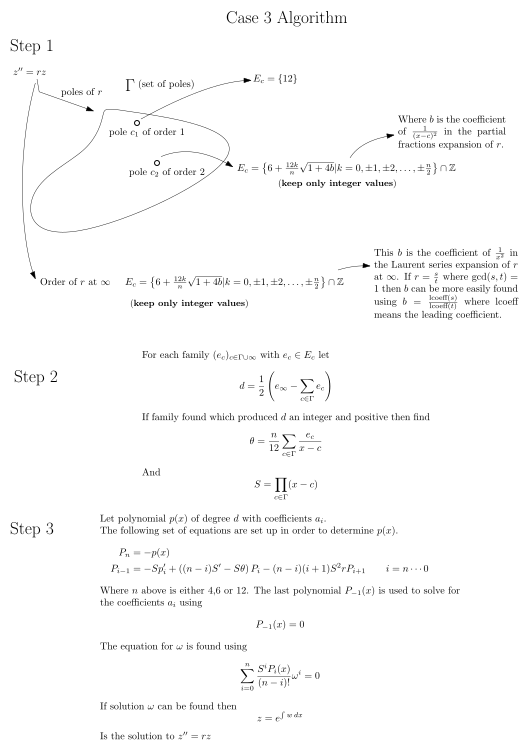
6.2.3.3 step 3

In this step the algorithm determines a polynomial \(p(x)=a_0+a_1 x+ a_2 x^2 + \dots + x^d\) of degree \(d\). Define set of polynomials \(\{P_n,P_{n-1},\cdots ,P_{-1}\) where

\begin{align*} P_n &= -p(x) && &&\\ P_{i-1} &= -S P_{i}' +\left ( (n-i) S' - S \theta \right )P_i -(n-i)(i+1) S^2 r P_{i+1} \qquad i=n \cdots 0 \end{align*}

The last polynomial \(P_{-1}(x)\) is used to solve for the coefficients \(a_i\) using

\begin{align*} P_{-1}(x) &= 0 \tag {2} \end{align*}

In Maple this is done using the solve command with the identity option. If it is possible to find coefficients \(a_i\) such that (2) is satisfied, then define the equation

\begin{align*} \sum _{i=0}^{n} \frac {S^i P_{i}(x)}{(n-i)!} \omega ^i = 0 \end{align*}

\(\omega \) is solved for from the above equation. If solution \(\omega \) is found then the solution to \(z''=r z\) will be

\begin{align*} z &= e^{\int \omega \,dx} \end{align*}

This completes the full algorithm for case three. The general solution to the original ode can now be determined as outlined at the end of case one above.